November 3, 2026
Potluck Recipes That Travel Well and Disappear First
Easy potluck recipes that travel well, plus how much to make, what to bring and how to keep food safe from your kitchen to the buffet table.

Potluck Recipes That Travel Well and Disappear First
The best potluck dish is one that survives the car ride, tastes good warm or at room temperature, serves a crowd from one pan and needs no last-minute work at the party. Think baked pasta, a slow cooker meatball, a sturdy salad, a dip with a sturdy scoop, or a sheet pan of brownies. Below you will find dishes sorted by what you were asked to bring, how much to make, and how to carry food so it is still safe to eat when the line forms.
TL;DR
- Pick a dish that holds well: baked pasta, slow cooker mains, grain or bean salads, dips and bar cookies beat anything that must be fried, tossed or plated at the last minute.
- Make 8 to 10 servings for a main or side, and a pan of 12 or more bars or squares for dessert, so a typical group gets a taste of everything.
- Keep cold food at 40°F or below and hot food at 140°F or above, and do not leave perishables out for more than two hours (one hour above 90°F).
- Bring your own serving utensil, label the dish with its main allergens and carry it in a container with a lid.
- Choose a recipe you have already made once. A potluck is a bad place for a first attempt.
Table of Contents
- What makes a potluck recipe actually work
- Main dishes that feed a crowd
- Side dishes that earn a second helping
- Appetizers and dips
- Desserts that do not need a refrigerator
- Easy potluck recipes for beginners
- How much to make
- Food safety: getting your dish there safely
- Make-ahead plan for a stress-free potluck
- What to bring when the host has not assigned anything
- Our perspective
- Find your next potluck dish on Forkward
- FAQ
- Sources
What makes a potluck recipe actually work
A good potluck dish has to pass four tests that a weeknight dinner never faces.
It travels. Your food will spend 20 to 60 minutes in a car, then wait on a counter. Anything with a crisp coating, a delicate sauce or a topping that wilts will be a different dish on arrival. Dishes baked in a single pan with a lid, or built in a slow cooker, move easily.
It holds. Good potluck food tastes fine after sitting for an hour. Pasta bakes, braised meats, meatballs, chili, marinated vegetables and bean salads often taste better after resting, because flavors settle in.
It serves itself. Guests are standing, holding a plate, and probably talking. Food that can be scooped with one spoon, or picked up with one hand, wins. A whole roast that needs carving loses.
It is labeled and safe. Someone at the table will have a nut allergy, someone will be vegetarian, and someone will be pregnant or have diabetes. A card with the dish name and main ingredients helps all of them, and temperature control keeps everyone well.

Main dishes that feed a crowd
If you are asked to bring a main, you are carrying the weight of the meal. Choose a dish that comes out of one vessel and stays hot or reheats easily.
Baked pasta and casseroles
Baked ziti, lasagna and chicken enchilada casserole are the backbone of American potlucks for a reason. You assemble them the day before, refrigerate them, and bake them on the morning of the event. Cover the pan tightly, wrap it in a towel or put it in an insulated carrier, and it will arrive hot. For recipe ideas, browse our easy pasta recipes, which include weeknight and weekend versions that scale up well to a 9x13 pan.

Slow cooker mains
Pulled pork, barbecue meatballs, chicken tinga, chili and Swedish-style meatballs all do well in a slow cooker, which doubles as a serving dish. If you cook at home and transport, the USDA advises reheating cooked food on the stove, in a microwave or in an oven to 165°F first, then placing it in a preheated slow cooker to keep it at 140°F or more, as described in its slow cooker safety guidance. In other words, use the slow cooker to hold food hot, not to bring cold leftovers up to temperature. If you want ideas for set-and-forget cooking, our roundup of easy crockpot dinners is a good starting point, and most of them work at potluck scale.
Sheet pan and oven-roasted options
Roasted chicken thighs with vegetables, sausage and peppers, or sliced oven-baked meatball subs cut into pieces all work from a sheet pan. They hold well under foil and slice into portions without a fuss. See our sheet pan dinners for flavor combinations to adapt.
Global crowd-pleasers
Many of the most popular potluck dishes today are not casseroles at all. Mongolian-style beef noodles, drunken noodles, chicken curry with rice, and taco bars all show up on potluck tables because they are bold, forgiving and easy to portion. If your group likes variety, our global weeknight dinners page has dishes that stretch into party-size batches.
Side dishes that earn a second helping
Sides are the safest category to bring because they are cheap, flexible and easy to scale. They are also where potlucks often end up with too many of the same thing, so ask the host what is already covered.
- Mac and cheese. Bake it in a disposable-safe pan with breadcrumbs on top. It reheats well and kids will eat it.
- Roasted vegetables and potatoes. Roasted carrots, green beans, sweet potatoes or smashed potatoes hold well at room temperature. Our roasted vegetables and potatoes page has simple options.
- Baked beans or charro beans. Cooked in advance and kept in a slow cooker, they stay warm for hours.
- Cornbread or rolls. A pan of cornbread cut into squares is easy to carry and easy to share.
- Pasta or grain salads. Orzo with lemon and herbs, farro with roasted vegetables, or a bean and corn salad are sturdy and need no heating.
If you plan to bring a salad, pick one that tolerates time on the table. We tested a set of them with temperature in mind in our guide to potluck salads. Dress leafy greens at the party, not before you leave. Dressing a hearty grain salad the night before is fine and often improves it.
Appetizers and dips
Appetizers are the easiest potluck assignment because they ask for the least equipment. The classics keep winning for a reason: hot bacon cheddar dip, taco dip, spinach artichoke dip, cheese balls and deviled eggs. The thing to remember is how they behave on a table.
- Hot dips should go in an oven-safe dish, then into a slow cooker or a warming tray on arrival. They turn greasy and stiff as they cool.
- Cold dips (layered taco dip, hummus, whipped feta) can sit on ice. Set the bowl inside a larger bowl of ice if it will sit out for a while.
- Finger foods like pinwheels, mini quiches or meatballs with picks should be sized so guests can eat them in one or two bites.
How much you need depends on how many people you are feeding. For menus built around 8, 16 or 30 guests, our guide to make-ahead appetizers for a crowd breaks down quantities and prep timing.
Desserts that do not need a refrigerator
A dessert you can cut and carry is a gift to the host, who is already juggling a full fridge. The best potluck desserts are bar cookies, brownies, sheet cakes, cobblers, and dessert dips with a sturdy cookie or fruit on the side.
- Brownies and blondies. Bake in a 9x13 pan and cut into 24 small squares. Small pieces matter, because guests like to try two or three desserts.
- Chocolate chip or oatmeal cookies. Always popular, they travel in a tin, and you can bake them the day before.
- Fruit cobbler or crisp. Serve it straight from the baking dish with a spoon. Bring whipped cream in a cooler if you want it.
- Cupcakes. A carrier with a lid keeps frosting intact. Skip piping tall swirls if you are driving far.
Cream cheese frostings, custard fillings, and whipped cream are perishable, so treat them like other cold foods. For dessert ideas, our easy dessert recipes cover cookies, brownies and cakes that suit a covered-dish table.
Easy potluck recipes for beginners
If you do not cook often, the goal is a dish with few steps, forgiving timing and cheap ingredients. A few that fit this description:
- Slow cooker meatballs. Frozen meatballs plus a jar of grape jelly and chili sauce is a famous shortcut, and a sauce of your own works too. Cook until hot, then hold on warm.
- Taco dip. Layer cream cheese, taco seasoning, salsa, shredded lettuce and cheese in a dish. No cooking at all, and it stays cold on ice.
- Baked ziti. Cooked pasta, jarred sauce, ricotta and mozzarella. Assemble, cover and bake.
- Sheet pan brownies. One bowl, one pan, a knife to cut them.
- Pasta salad. Cooked rotini with chopped vegetables, cubed cheese and Italian dressing. Taste it before you leave and add salt or vinegar if it seems flat after chilling.
If you are new to the kitchen, pick the recipe that sounds least impressive and make it well. Nobody remembers a fancy dish that arrived cold or collapsed in the car. They remember the pan that was empty first.
How much to make
The most useful rule is to scale to the category, not just to the headcount. If 20 people are coming and each person brings one dish, you do not need 20 portions of every dish. You need a spread where people can take a small serving of several things.
As a working guide, plan on these amounts per dish, and adjust for your group:
| Category | Typical amount per dish | Notes |
|---|---|---|
| Main dish | 8 to 10 servings | One 9x13 pan or a 5 to 6 quart slow cooker |
| Side dish | 8 to 10 servings | Bring more if few sides are planned |
| Appetizer | About 4 to 5 pieces per guest | Count the whole group, not just your category |
| Dessert | 10 to 12 portions | Cut small so guests can sample |
These figures are planning rules of thumb that potluck organizers commonly use, not official requirements. The simplest way to use them: ask the host how many people are coming and how many other dishes are planned. If there are 24 guests and 6 mains, each main only needs to feed about 4 people on average. If only two mains are expected, make a full pan.
If you are bringing turkey for a holiday potluck, the USDA suggests planning half a pound of turkey per person, according to its guidance on food safety and gatherings. When in doubt, make a bit extra of a main that reheats well, since leftovers are easy to send home.
Food safety: getting your dish there safely
Potluck food is often prepared in many different kitchens, transported, and left out for hours. That is a recipe for trouble if you ignore temperature. The good news is that the rules are short.
Keep hot food hot and cold food cold
The USDA recommends carrying cold food in a cooler with ice or gel packs so it stays at 40°F or below, and keeping hot food at 140°F or above with insulated bags or towels. It also says perishable food should not sit out for more than two hours, or more than one hour when the temperature is above 90°F, as laid out in its potluck food safety recommendations. A summer picnic potluck therefore has half the time window of a winter indoor one.
Practical steps:
- Pack cold dishes in a cooler, and put the cooler in the passenger area of the car rather than a hot trunk.
- Wrap hot casseroles in towels, then place them in an insulated carrier or a box lined with newspaper.
- Bring a food thermometer. It takes the guesswork out of whether the pan is still at 140°F.
- Use a slow cooker, chafing dish or warming tray on site, if the host allows it.
Prep and cook cleanly
North Dakota State University Extension advises preparing food in a kitchen suited to cooking in quantity, keeping hands clean, serving small portions when you are unsure how quickly food will be eaten, and not adding fresh food to a serving dish that already holds food, as explained in its community potluck food safety publication. The same source warns against partially cooking food to finish later, because that can increase bacterial growth. Cook it fully, cool it, refrigerate it, and reheat it just before serving.
University of Minnesota Extension adds simple hygiene rules for anyone cooking for a crowd: trim fingernails, remove jewelry, tie back long hair, cover cuts, and do not handle food if you or someone in your household has vomiting, diarrhea or a diagnosed foodborne illness, as listed in its guide to cooking safely for a crowd.
Think about who is eating
The USDA notes that pregnant women, seniors, transplant recipients, cancer patients and people with diabetes may be at higher risk of foodborne illness, in its note on sharing food safely. If you are cooking for a mixed-age group, that is one more reason to keep the thermometer handy and to label dishes that contain raw or undercooked ingredients. Anyone in a higher-risk group who has questions about particular foods should ask their doctor.
Make-ahead plan for a stress-free potluck
The best potluck cooks do the work early so the day of the party is easy.
- Two to three days ahead: Pick the recipe, shop, and make any sauce, braise or dressing. Cool and refrigerate promptly.
- The day before: Assemble casseroles and bakes, mix grain salads, bake bars and cookies. Cut desserts after they are fully cool.
- The morning of: Bake or reheat hot dishes, pack the cooler, label the dish and add the serving utensil. Dress delicate salads at the party.
- On arrival: Get cold food into the fridge or onto ice, and hot food onto a warmer, as soon as you can.
- Before you leave: Check what is left. Perishables that sat out for over two hours should be thrown away, not sent home with guests.
If your potluck is a holiday event, our make-ahead Thanksgiving sides plan lays out a seven-day schedule that fits a work-friendly week and works for any big gathering.
What to bring when the host has not assigned anything
If the invitation says “just bring something,” use this quick decision list.
- Ask first. A short text to the host (“Is there anything you are short on?”) saves a table full of chips.
- Default to a side or dessert. Most potlucks end up with too many mains and not enough fillers.
- Bring something for people who skip meat or gluten. A bean salad, roasted vegetables or fruit-based dessert makes someone’s night.
- Bring a dish you can describe in one sentence. “Lemon orzo with feta” gets eaten faster than “mystery salad.”
- Bring the utensil. A serving spoon or spatula is the most forgotten item at every potluck.
Our perspective
At Forkward Kitchen, we think potluck cooking is one of the best tests of a recipe. A dish has to work in your kitchen, in a car, on a counter, and on a paper plate held by a hungry guest. That is a harder test than a quiet dinner at home, and it is why we write and test every recipe ourselves instead of collecting other people’s.
We also think honest difficulty ratings matter more for a potluck than for any other meal. If a recipe needs last-minute attention, we say so. If it is forgiving enough for a beginner and scales to a crowd, we say that too. Our goal is that you can pick a recipe on Tuesday, cook it on Friday, and show up on Saturday knowing it will be good.
Great potluck food does not have to be expensive or fussy. It has to be reliable, generous and made with care, and we build our recipes around that idea.
Oloru
Find your next potluck dish on Forkward
When you want a tested recipe rather than a guess, start with our full collection of original recipes. Each one includes a difficulty rating, complete instructions and practical tips, so you can choose a quick weeknight bake or a weekend project and know what you are getting into. Cooks looking for a challenge can try our advanced recipes for a showpiece dish.
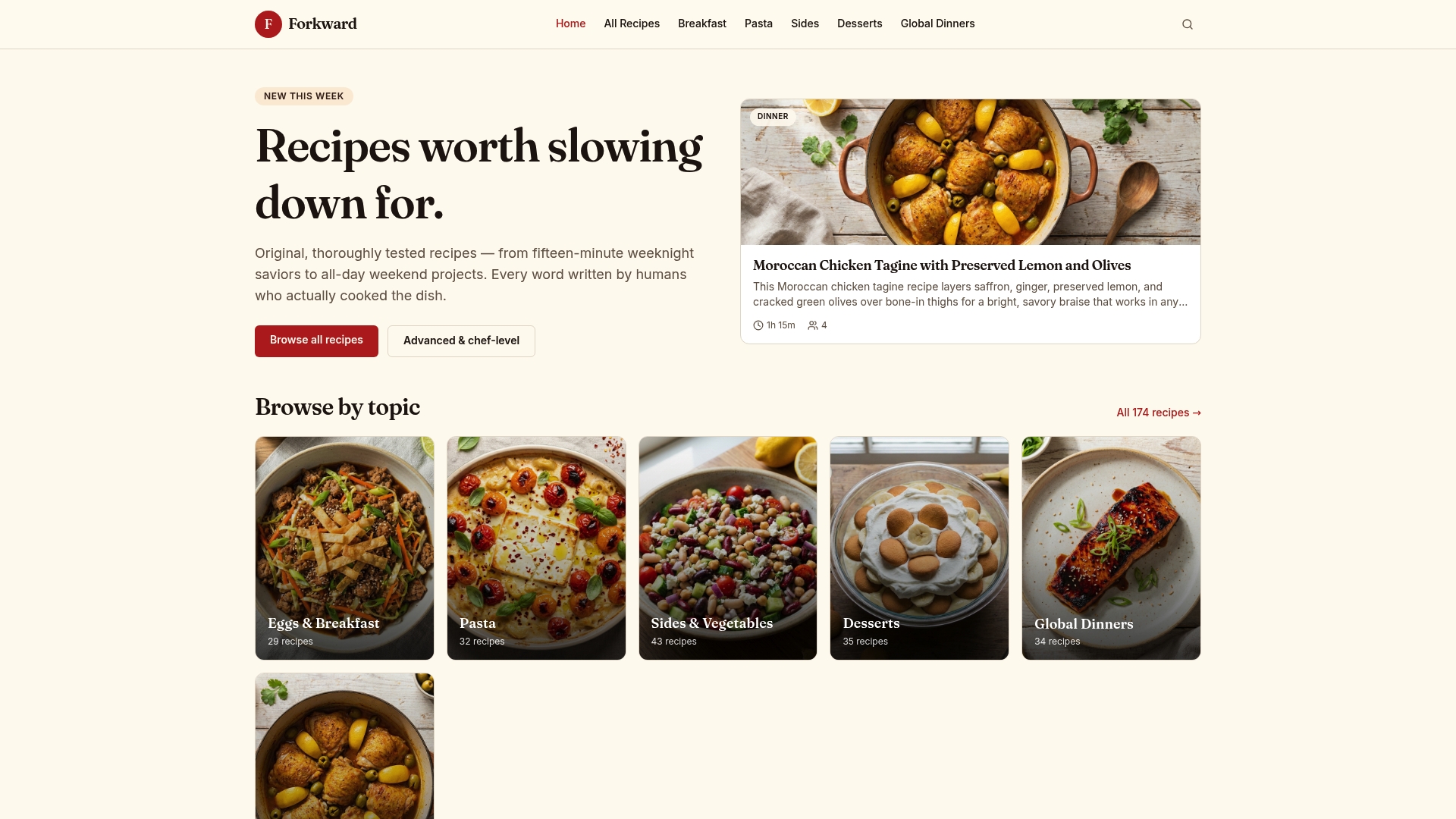
If you are bringing a salad, a make-ahead appetizer or a dessert, the pages linked above are a good place to start, and our homepage has the latest recipes.
FAQ
What is the easiest dish to bring to a potluck?
Taco dip, baked ziti, pasta salad and sheet pan brownies are among the easiest. They need few ingredients, tolerate imperfect timing and travel in a single container. If you only have 30 minutes, taco dip and brownies need no special skills.
How far ahead can I make potluck food?
Most casseroles, grain salads, braised meats and bar desserts can be made a day ahead and refrigerated. Cook food fully, cool it promptly and reheat hot dishes just before you leave. Do not partially cook food to finish later, since that can increase bacterial growth, according to NDSU Extension.
How do I keep food warm during transport?
Wrap a hot, covered dish in towels and put it in an insulated bag or cooler with no ice, or a box that fits snugly. The USDA says hot food should stay at 140°F or above. Use a thermometer on arrival, and if the dish has dropped below that, reheat it to 165°F before serving.
How much food should I bring if I do not know the guest count?
Ask the host for a rough count and how many dishes are planned. If you cannot, make 8 to 10 servings of a main or side, or 10 to 12 portions of dessert. That is enough to share without leaving you with a full pan to carry home.
What should I bring if I have no time to cook?
A fruit platter, a bag of good tortilla chips with a jar of salsa and a tub of guacamole, or a store-bought pie are all acceptable. Keep cold items on ice, bring a serving utensil, and label anything that contains common allergens such as nuts or dairy.
Sources
- USDA: food safety recommendations for your potluck
- USDA: Share the Love, not the Bacteria
- USDA FSIS: Slow Cookers and Food Safety
- NDSU Extension: Keep Food Safe at Community Dinners and Potlucks
- UMN Extension: Cooking safely for a crowd