July 27, 2026
Easy Sheet Pan Dinners for Busy Weeknights
Discover easy sheet pan dinners that save time and cleanup! Enjoy delicious meals with minimal prep using just one pan. Perfect for busy weeknights!

Easy Sheet Pan Dinners for Busy Weeknights
A sheet pan dinner is a complete meal roasted on a single rimmed baking sheet — protein, vegetables, and seasoning all cooked together with minimal prep and one pan to wash. That’s the whole idea, and it works.
- A rimmed baking sheet keeps drippings in the pan and ingredients from sliding off; parchment or foil makes cleanup a non-issue.
- Single-pan roasting lets the oven do the work while you do something else.
- This article covers a timing cheat sheet, a categorized recipe shortlist, and Forkwardkitchen’s tested picks with honest difficulty ratings.
Table of Contents
- What tools and pantry basics do you actually need?
- Oven temps and cooking times: your quick reference
- Six sheet pan recipes worth trying tonight
- How do you swap proteins and adapt recipes?
- Cleanup, storage, and food safety
- Forkwardkitchen’s tested sheet pan picks
- Key Takeaways
- What the test kitchen keeps getting wrong (and then right)
- More tested recipes from Forkwardkitchen
- Useful sources
What tools and pantry basics do you actually need?
You don’t need much. The right pan matters more than any specialty gadget.
The pan itself: A half-sheet pan is the standard size for most home ovens and handles a full dinner for four without crowding. Quarter-sheet pans work for one or two servings. Avoid thin, flimsy pans — they warp at high heat and cook unevenly. Nordic Ware half-sheet pans are a reliable, widely available choice.
Lining the pan: Parchment paper is the cleaner option for most roasting. It won’t react with acidic ingredients (lemon juice, tomatoes) the way foil can, and it’s compostable. Foil works fine for stickier glazes and is easier to mold around pan edges. If you want to skip liners entirely, a well-seasoned or nonstick pan roasted at high heat cleans up faster than you’d expect.
Everything else: Tongs for tossing and turning, a large mixing bowl for coating ingredients evenly, and an instant-read thermometer. The thermometer is non-negotiable — time alone won’t tell you when chicken is safe.
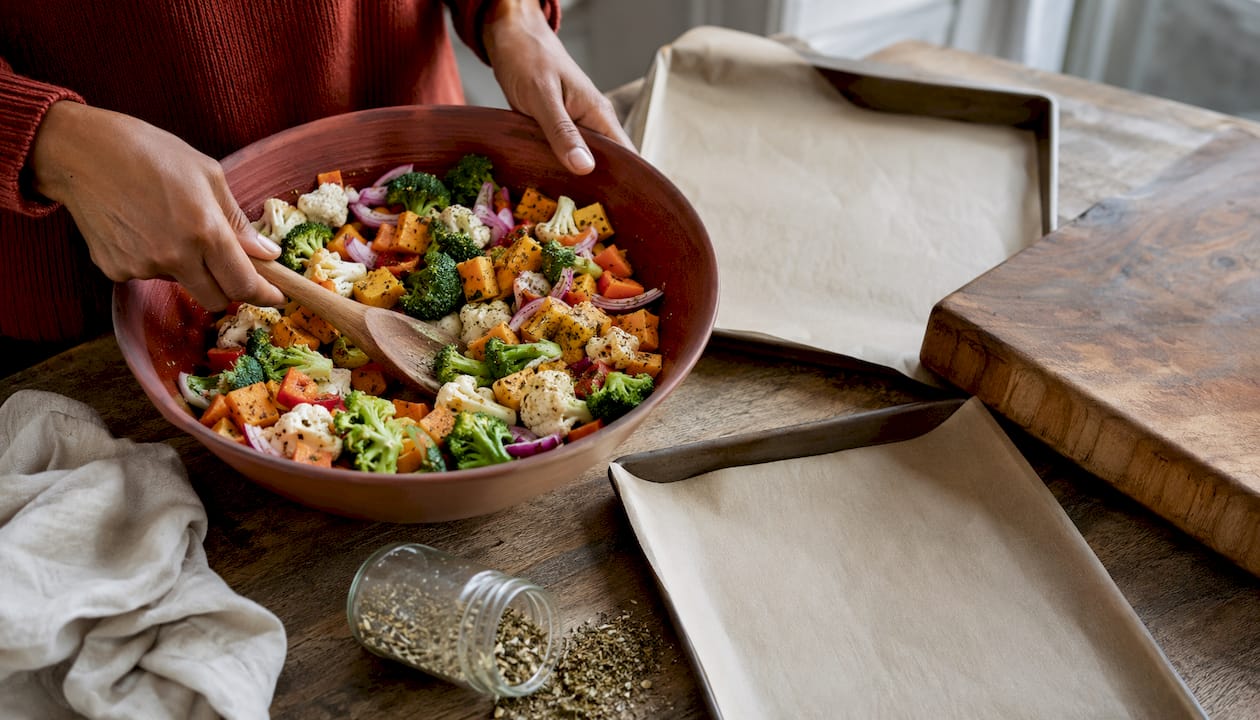
Rack position: Center rack for most dinners. If you’re running two pans at once, rotate them halfway through and swap racks so both get even heat.
Pro Tip: Pat proteins completely dry before seasoning. Moisture on the surface steams instead of browns, and you’ll lose the crisp skin or crust you’re roasting for. A paper towel and 30 seconds make a real difference.
Oven temps and cooking times: your quick reference
Use this table as a starting point. Every oven runs slightly different, so pull out the thermometer for proteins.
| Ingredient | Oven Temp | Approx. Time | Notes |
|---|---|---|---|
| Chicken thighs (bone-in) | 425°F | 35–40 min | Most forgiving; internal temp 165°F |
| Chicken breasts | 400°F | 20–25 min | Reduce time by 5–10 min vs thighs; watch closely |
| Salmon fillets | 400°F | 12–15 min | Flakes easily at 125–130°F internal |
| Shrimp (large) | 425°F | 6–8 min | Add in the last 8 minutes; overcooks fast |
| Sausage (sliced) | 400°F | 20–25 min | Slice for faster, more even browning |
| Potatoes (cubed) | 425°F | 30–40 min | Start first; cut uniform for even cooking |
| Carrots (sliced) | 425°F | 25–30 min | Add with potatoes |
| Broccoli florets | 425°F | 18–20 min | Add halfway through potato cook time |
| Asparagus | 425°F | 10–12 min | Add in the last 12 minutes |
High heat (400–450°F) is the default for sheet pan cooking. It drives caramelization and browning. Lower temps (375°F) work for delicate fish or when you’re combining very different cook times on one pan.
Staggering is the key move. Start dense root vegetables 15–20 minutes before proteins. Add quick-cooking items like shrimp or asparagus in the final 8–12 minutes. Everything lands at the table done at the same time.
Finishing under the broiler for the final 5–10 minutes adds caramelization and crisps skin without overcooking the interior. Watch closely — it goes from golden to burnt fast.
Common problems and quick fixes:
- Undercooked potatoes: Cut them smaller next time, or start them 10 minutes earlier.
- Dry chicken breasts: Pull at 160°F (carryover heat finishes the job) and don’t skip the rest.
- Soggy vegetables: The pan is too crowded. Crowding causes steaming, not roasting. Use two pans or reduce the quantity.
Six sheet pan recipes worth trying tonight
These cover the main categories — pick by protein, flavor mood, or what’s already in your fridge.
-
Sheet Pan Chicken Thighs with Lemon and Garlic | Difficulty: Easy | Bone-in thighs roast at 425°F for 35–40 minutes alongside potatoes started 15 minutes earlier. Thighs are the most forgiving cut on a sheet pan — hard to overcook, easy to flavor. Toss everything in olive oil, garlic, and lemon zest before it goes in.
-
Sheet Pan Salmon with Dill Potatoes | Difficulty: Easy | Salmon fillets at 400°F for 12–15 minutes, potatoes started 20 minutes ahead. The fish is done when it flakes at the thickest point. A simple dill-butter finish takes 30 seconds and makes it feel like more effort than it was.
-
Sheet Pan Sausage and Veggies with Hot Honey Broccolini | Difficulty: Easy | Sliced sausage and broccolini at 400°F for 20–25 minutes. The hot honey and lemon finish keeps leftovers interesting the next day — this one actually improves overnight.
-
Sheet Pan Shrimp Fajitas | Difficulty: Easy | Peppers and onions at 425°F for 15 minutes, shrimp added for the final 6–8 minutes. Season with cumin, smoked paprika, and lime. Fast enough for a Tuesday.
-
Sheet Pan Vegetarian Fajitas (or Cauliflower Tacos) | Difficulty: Easy | Cauliflower florets, peppers, and black beans roasted at 425°F for 20–25 minutes. Chipotle seasoning and a tahini drizzle at the end. Fully plant-based, genuinely satisfying.
-
Sheet Pan Pizza | Difficulty: Easy–Medium | Press store-bought or homemade dough onto a well-oiled sheet pan, top, and bake at 450°F for 15–18 minutes. The pan’s edges give you that thick, focaccia-style crust. Add toppings in the last 8 minutes if they’re delicate.
How do you swap proteins and adapt recipes?
The core rule: match density and cook time, not just category. Swapping chicken thighs for breasts isn’t a one-to-one trade — breasts need 5–10 fewer minutes and a closer eye on temperature. Swapping potatoes for sweet potatoes is nearly seamless; they cook at the same rate and absorb seasoning the same way.
Plant-forward swaps: Chickpeas roast beautifully at 425°F for 20–25 minutes and replace chicken in most recipes. Firm tofu works too — press it dry, cube it, and treat it like a dense vegetable. For a fully vegan pan, swap butter finishes for olive oil or tahini.
Gluten-free: Most sheet pan dinners are naturally gluten-free. Watch seasoning blends and sauces (soy sauce, some hot sauces) for hidden gluten; tamari is a clean swap.
Timing adjustments when you swap: Dense roots (beets, turnips, parsnips) need 35–40 minutes and go in first. Leafy greens (kale, spinach) go in the last 5 minutes or they’ll burn. When you add a new ingredient, ask: is it denser or lighter than what it’s replacing? Add 5–10 minutes for denser, subtract for lighter.
Seasoning swaps that reliably work: Za’atar with lemon for Mediterranean flavor; smoked paprika and cumin for a Southwestern profile; ginger, soy, and sesame for an Asian-inspired pan. Tossing all ingredients thoroughly in oil and seasoning before roasting is what makes the pan juices become a built-in sauce rather than just drippings.
For more vegetable pairing ideas, Forkwardkitchen’s sides collection covers roasted vegetable combinations that work across multiple protein swaps.
Cleanup, storage, and food safety
Lining and cleanup: Parchment is the easiest cleanup — lift it out, toss it, wipe the pan. Foil works for sticky glazes but can bond to the pan if sugars caramelize hard. For bare-pan roasting, deglaze with a splash of water while the pan is still warm and the fond lifts right off.
Scaling up: One pan feeds three to four people comfortably. For six or more, split across two pans and rotate them halfway through cooking. Stacking pans on the same rack blocks airflow and extends cook time unpredictably.
Storage and reheating:
- Cool leftovers within two hours of cooking before refrigerating.
- Store in airtight containers; most sheet pan meals keep well for three to four days.
- Reheat at 350°F in the oven for 10–12 minutes to restore texture; the microwave works but softens any crisp edges.
- Shrimp and fish are best eaten within two days and don’t reheat as well as chicken or sausage.
Food safety targets: Chicken must reach an internal temperature of 165°F. Pork sausage reaches safe temperature at 160°F. Salmon is safe at 145°F, though many cooks prefer 125–130°F for texture. Use a thermometer every time — the hands-off roasting workflow makes it easy to forget the pan is in the oven, and time estimates vary by oven and ingredient thickness.
For family-sized meal planning beyond sheet pan dinners, this weeknight guide covers batch-cooking strategies that pair well with the storage approach above.
Forkwardkitchen’s tested sheet pan picks
These are recipes Forkwardkitchen has developed and tested from scratch, each with an honest difficulty rating and the one tip that makes it work reliably.
One Pan Chicken Thighs and Potatoes with Lemon and Garlic | Easy Bone-in thighs and Yukon Gold potatoes at 425°F. The fail-safe tip: pat the thighs completely dry and start the potatoes 15 minutes before the chicken goes in. The result is crisp skin and fully cooked potatoes without any guesswork.
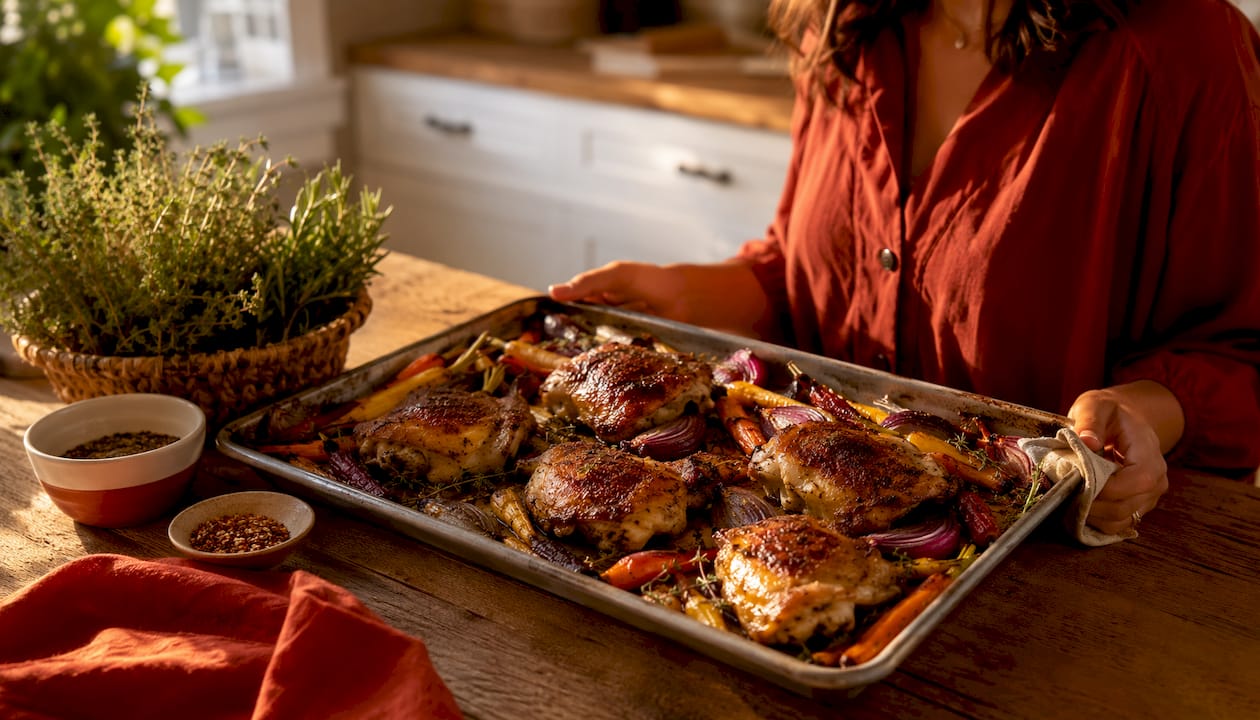
Sheet Pan Sausage and Veggies with Hot Honey Broccolini | Easy Sliced sausage, broccolini, and a hot honey-lemon finish. The tip here is slicing the sausage on a bias — more surface area means more browning. This one travels well into lunch the next day.
Pro Tip: For any sheet pan recipe with a glaze or sauce finish, add it in the last 5 minutes of roasting rather than at the start. Sugar-based glazes burn before the protein is cooked through if they go on too early.
Forkwardkitchen’s tested recipe collection covers both of these in full, with step-by-step instructions and difficulty ratings that reflect real cooking experience, not optimistic estimates.
Key Takeaways
Sheet pan dinners succeed or fail on three things: pan space, ingredient staging, and a thermometer.
| Point | Details |
|---|---|
| Single layer, always | Crowding the pan causes steaming; spread ingredients in one layer or use two pans. |
| Stage by density | Start dense vegetables 15–20 minutes before proteins; add quick items like shrimp last. |
| Thermometer over timer | Pull chicken at 165°F, salmon at 125–130°F — oven times vary too much to rely on alone. |
| Broiler finish | A 5–10 minute broil at the end adds caramelization and crispness without overcooking. |
| Forkwardkitchen tested picks | The lemon-garlic chicken thighs and hot honey sausage recipes are tested, rated Easy, and built for real weeknights. |
What the test kitchen keeps getting wrong (and then right)
The most common failure in sheet pan cooking isn’t the recipe — it’s the pan. Home cooks consistently underestimate how much space ingredients need to actually roast. A pan that looks full going into the oven produces soft, steamed food coming out. The fix is boring but reliable: use a second pan, or cook in batches.
The second thing that trips people up is treating the timing table as a guarantee. Ovens vary by 25–50°F from their stated temperature, and ingredient thickness changes everything. A thick chicken breast and a thin one behave like different proteins at the same temperature. The thermometer solves both problems at once.
What the test kitchen has found is that the recipes people return to are almost always the simplest ones: a good fat, a sharp acid, a seasoning blend they already like, and a protein that forgives a few extra minutes in the oven. Chicken thighs, sausage, and salmon cover most weeknights. Everything else is a variation on the same method.
More tested recipes from Forkwardkitchen
If tonight’s dinner is handled, the full recipe collection at Forkwardkitchen has every sheet pan dinner above in complete form — with step-by-step instructions, tested timing, and difficulty ratings that are honest about what each recipe actually asks of you.
Every recipe on the site is developed from scratch and cooked through before it’s published. No curated roundups, no untested timing estimates. If you want a reliable weeknight rotation beyond sheet pan meals, the easy weeknight dinners collection covers global flavors with the same low-fuss approach. Save one, pin one, and let the oven do the rest.
Useful sources
- Sheet pan recipes — Food Network: Equipment basics and a broad collection of sheet pan ideas; useful for understanding pan types and lining options.
- Most-saved sheet pan dinners — Serious Eats: Technique-focused guidance on seasoning, oil distribution, and why ingredient combinations work as a flavor system.
- Easy sheet pan chicken — NYT Cooking: Timing guidance for chicken thighs vs. breasts and the case for monitoring internal temperature.
- Sheet-Pan Supper — NYT Cooking: Practical notes on cutting ingredients uniformly and staggering cook times for mixed-ingredient pans.
- Sheet-Pan Chicken and Potatoes with Feta, Lemon and Dill — NYT Cooking: The clearest explanation of why pan crowding causes steaming and how to fix it.
- Sheet-Pan Hot Honey Chicken and Peaches — Bon Appétit: Broiler-finish technique and timing for adding caramelization without burning.
- Sheet Pan Chicken and Potatoes — Yellow Bliss Road: Practical staging workflow for dense vegetables and proteins on one pan.
- One Pan Chicken Thighs and Potatoes with Lemon and Garlic — Forkwardkitchen: Forkwardkitchen’s tested recipe with technique notes on patting proteins dry and staggering potatoes.
- Sheet Pan Sausage and Veggies with Hot Honey Broccolini — Forkwardkitchen: Tested sausage-and-vegetable dinner with notes on glaze timing and leftover quality.