August 18, 2026
Homemade Pasta Dough: A Beginner's Guide That Works
Master the art of homemade pasta dough with our easy guide! Just flour and eggs create delicious pasta for any meal. Get started today!
Homemade Pasta Dough: A Beginner’s Guide That Works
A reliable homemade pasta dough comes down to one ratio: 100 grams of flour for every large egg. That’s it. Get that right, knead until smooth, rest for 30 minutes, and you have dough ready for tagliatelle, ravioli, or pappardelle.
Here’s the everyday version to start with tonight:
- 250 g (about 2 cups) all-purpose or “00” flour
- 2 large eggs
- 1 tablespoon olive oil
- ½ teaspoon salt
This makes enough fresh pasta for several dinner portions. Total time runs about an hour, including mixing, kneading, resting, rolling, and cutting.
Ratio callout: Scaling up or down is simple once you lock in 100 g flour per egg. Feeding six people? Use 400 g of flour and 4 eggs. Cooking solo? Halve everything, though a tiny egg is tough to portion, so many cooks use one whole egg for a single-serving batch and just accept a slightly wetter dough.
Key Takeaways
A dependable homemade pasta dough uses 100 grams of flour per large egg, rests for at least 30 minutes, and rewards small, incremental fixes over drastic ones.
| Point | Details |
|---|---|
| Lock in the ratio | Use 100 g flour per egg as your baseline, then scale proportionally for any batch size. |
| Rest before rolling | Wrap dough and rest at least 30 minutes so gluten relaxes and sheets roll without snapping back. |
| Fix hydration gradually | Add water by the drop or flour by the pinch instead of large additions to avoid overcorrecting. |
| Choose flour by shape | Use “00” for silky ribbons, bread flour for chew, and semolina for egg-free rustic shapes. |
| Freeze for later | Flash-freeze cut pasta on a tray before bagging so pieces don’t clump together. |
Table of Contents
- How to Make Homemade Pasta Dough: Ingredients and Ratios
- What Equipment Do You Need for Fresh Pasta?
- How Do You Knead, Rest, and Roll Pasta Dough?
- Egg Dough vs. Semolina Dough: Which Should You Make?
- How Long Does Fresh Pasta Take to Cook?
- Why Is My Pasta Dough Too Dry, Sticky, or Springing Back?
- The Science Behind Why Pasta Dough Ratios Work
- What Sauces and Shapes Work Best for Beginners?
- A Note From Forkward Kitchen’s Kitchen
- Frequently Asked Questions
- Sources
How to Make Homemade Pasta Dough: Ingredients and Ratios
Flour choice shapes texture more than most beginners expect. Standard recipes lean on 2 cups of flour to 2 or 3 eggs, sometimes with a splash of olive oil for elasticity, and that flexibility in egg count is exactly why the 100 g per egg guideline works better than a fixed recipe you can’t adjust.
| Flour Type | Texture Result | Best For |
|---|---|---|
| “00” flour | Silky, delicate, tender bite | Ravioli, tagliatelle, thin sheets |
| All-purpose flour | Reliable, slightly firmer | Everyday pasta, beginners |
| Bread flour | Chewier, more structure | Thicker cut shapes, pappardelle |
| Semolina (durum) | Firm, toothsome, egg-free option | Orecchiette, cavatelli, pici |
“00” flour is milled finer than all-purpose, which is why it produces that glassy, restaurant-style sheet. Bread flour’s higher protein content builds more gluten, giving cut noodles a satisfying chew. Semolina works differently entirely. It’s coarser and pairs with water instead of eggs for rustic southern Italian shapes.
A few adjustments worth knowing:
- Extra egg yolks in place of whole eggs make the dough richer and more golden, common in Emilia Romagna style pasta.
- A tablespoon of olive oil adds pliability and makes rolling easier for beginners.
- One large egg typically weighs 50 to 55 grams, but egg sizes vary by carton and brand, so treat 100 g as a target rather than gospel.
Humidity and flour age also affect how much liquid your dough actually needs. Flour absorbs moisture from the air over time, and a humid kitchen changes hydration on the fly. Recipes are guides, not laws here. Add flour or water in small increments until the dough feels right, not until the recipe says you’re done.
What Equipment Do You Need for Fresh Pasta?
You don’t need much to start. A clean counter, a bench scraper, and a rolling pin will get you a finished dish tonight.
Essential tools:
- Clean, flat work surface (wood or laminate both work)
- Bench scraper for cutting and cleaning up dough
- Rolling pin (a long, thin one works better than a standard baking pin)
- Sharp knife for cutting ribbons
- Semolina or cornmeal for dusting
Helpful but optional:
- Pasta machine (manual crank or stand mixer attachment)
- Stand mixer with a dough hook for the kneading stage
- Food processor for a fast, hands-off mix
A pasta machine earns its keep by producing even thickness across the whole sheet, something a rolling pin makes harder to nail consistently. But plenty of home cooks roll by hand for years before buying one, and a rolling pin is genuinely fine for beginners who want to test whether they’ll stick with this hobby. For drying cut pasta, a clean kitchen towel draped over a chair back or a wooden pasta rack both work as improvised nests.
How Do You Knead, Rest, and Roll Pasta Dough?
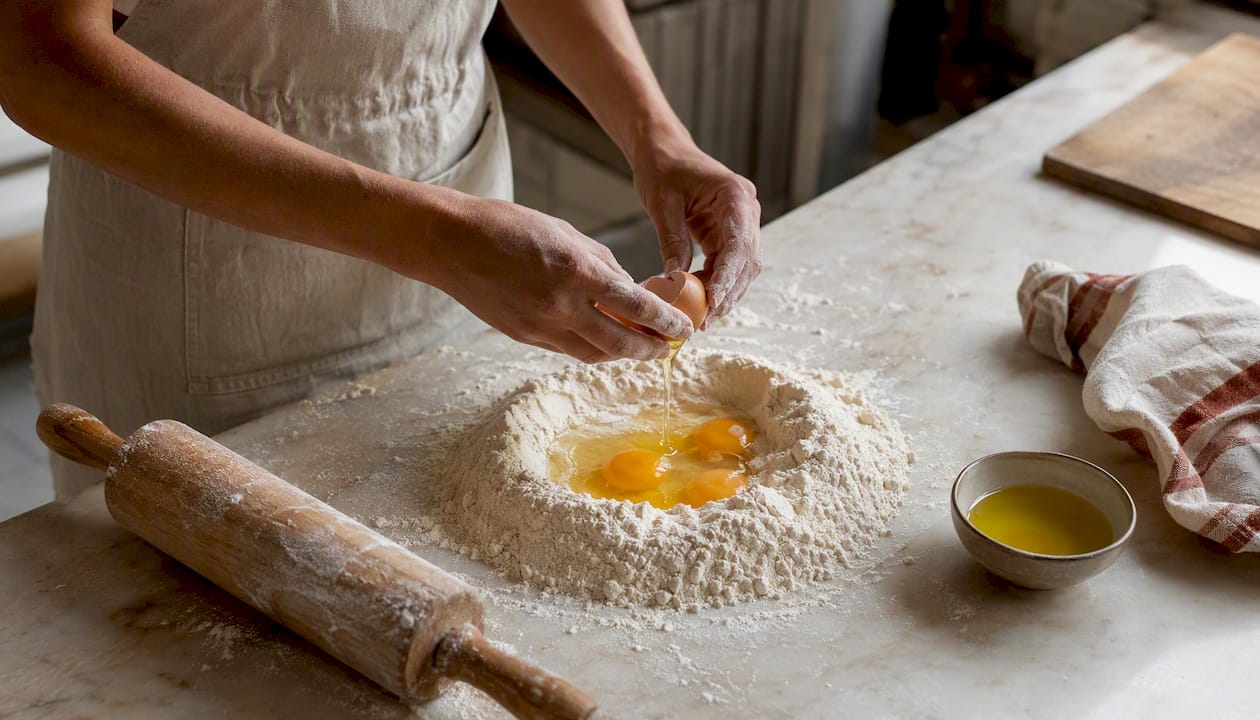
Making dough by hand starts with a well, the classic mound-of-flour-with-a-crater-in-the-middle method that looks intimidating and isn’t.
- Build the well. Pile flour on your work surface and make a wide crater in the center. Crack eggs into the well along with oil and salt.
- Whisk gently. Use a fork to beat the eggs inside the well, slowly pulling in flour from the inner walls. Keep the outer flour wall intact so eggs don’t run everywhere.
- Bring it together. Once the mixture thickens, use a bench scraper to fold in remaining flour until you get a shaggy, rough mass. It’ll look like it’s not going to work. It’s supposed to look that way.
- Knead by hand, 8 to 10 minutes. Push the dough away with the heel of your palm, fold it back over itself, rotate a quarter turn, repeat. The dough transforms from lumpy to smooth over this stretch, and that shift from shaggy to silky is the single biggest confidence moment for new pasta makers.
- Check readiness. Press a finger into the dough. If it springs back quickly, gluten has developed enough. The surface should look smooth and slightly tacky, not wet.
- Rest, 30 minutes minimum. Wrap the dough tightly in plastic and let it sit at room temperature. This is not optional. Skipping it means gluten stays tight and every sheet you roll will spring back on you.
- Roll it out. If using a machine, start on the widest setting and pass the dough through, folding it in thirds between passes for the first few rounds. Move down one setting at a time until you reach your target thickness, usually setting 5 to 7 on most home machines. By hand, roll from the center outward, rotating the dough a quarter turn frequently to keep the shape even.
- Test the thickness. Hold the sheet up to light. You should be able to see a faint shadow of your hand through it for filled pasta like ravioli; ribbons can be slightly thicker.
- Cut your shape. Dust lightly with semolina, fold loosely, and slice with a sharp knife for tagliatelle or pappardelle, or run through a machine’s cutting attachment.
If you use a stand mixer or food processor to combine the initial dough, pulse eggs and flour together until it forms coarse crumbs, then finish kneading by hand. The finish-by-hand step matters because you need to feel the dough, not just watch it.
A few texture cues to watch for as you work. Dough that feels dry and won’t come together needs water, added a few drops at a time, not by the spoonful. Dough that’s sticking to your hands and the counter needs a light dusting of flour, worked in gradually. Dip your fingers in water rather than adding measured tablespoons, since that micro-addition method is how you avoid overshooting into a gummy mess.
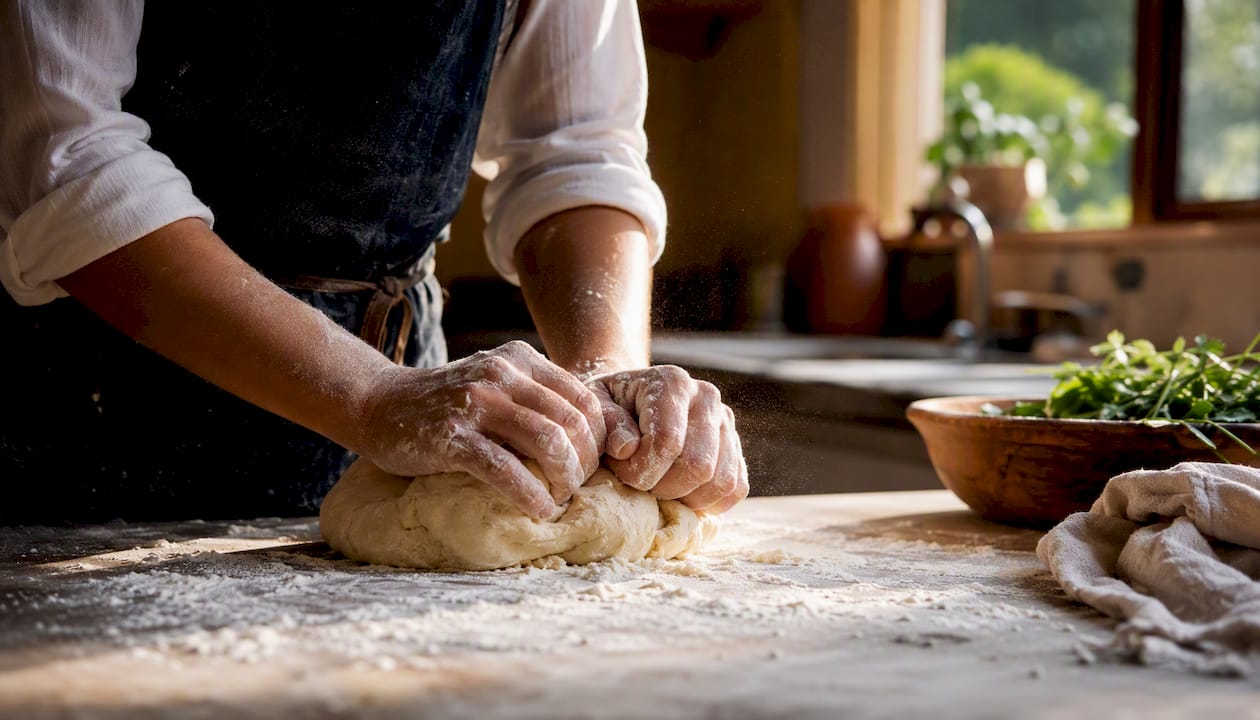
Pro Tip: Cut a small piece off your rested dough and look at the cross-section. Tiny, evenly distributed air bubbles mean you’ve kneaded it enough. A dense, solid-looking cut means a few more minutes of kneading will pay off.
Timing overview for the whole process:
- Mixing and forming: 5 to 10 minutes
- Kneading: 8 to 10 minutes
- Resting: 30 minutes (can extend to a few hours in the fridge)
- Rolling and cutting: 15 to 20 minutes
Egg Dough vs. Semolina Dough: Which Should You Make?
Northern Italy built its pasta tradition on eggs. Southern Italy built its on flour and water. Both are legitimate homemade pasta dough, they just serve different jobs.
Egg dough (100 g flour to 1 egg, following our BLUF ratio) gives you tender, rich sheets ideal for ravioli, tortellini, and long ribbons like tagliatelle. Semolina dough skips eggs entirely, relying on durum wheat and warm water for a firmer, more rustic bite suited to hand-shaped forms like orecchiette, cavatelli, and pici. BBC Good Food’s version uses about 400 g semolina to 190 to 200 ml warm water, kneaded until smooth just like the egg version, minus the well-building step since there’s no egg to contain.
| Attribute | Egg Dough | Semolina Dough |
|---|---|---|
| Typical hydration | Moderate (from eggs) | Higher (added water) |
| Best for | Ribbons, filled pasta | Rustic, hand-rolled shapes |
| Texture | Silky, tender | Firm, chewy |
| Equipment | Machine or rolling pin | Hands, no machine needed |
If you’re torn, start with egg dough. It’s more forgiving for a first attempt, and a pasta machine makes quick work of it.
How Long Does Fresh Pasta Take to Cook?
Fresh pasta cooks fast, which surprises people used to boxed dried noodles. Thin ribbons like tagliatelle need just 1 to 2 minutes in well-salted, rapidly boiling water. Thicker cuts or filled pasta like ravioli run 3 to 4 minutes. Always taste a piece before draining, since thickness varies batch to batch.
Scoop out a cup of starchy pasta water before draining. It’s the secret to a sauce that clings instead of pooling at the bottom of the bowl.
Storage and freezing:
- Refrigerate raw dough tightly wrapped in plastic for up to 2 days.
- Dust cut pasta with semolina, coil into nests, and cover loosely; use within a day or refrigerate a few hours.
- To freeze shaped pasta, spread pieces flat on a parchment-lined tray, freeze until solid, then transfer to a bag. This prevents clumping.
- Cook frozen pasta directly from the freezer without thawing; the cooking time will be slightly longer.
Why Is My Pasta Dough Too Dry, Sticky, or Springing Back?
Dough feels dry and crumbly. Add water one drop at a time, kneading between additions, rather than pouring in a tablespoon at once.
Dough sticks to everything. Dust your hands and work surface lightly with flour and keep kneading. Resist the urge to dump in a large handful; small corrections work better than big ones.
Dough snaps back when rolling. It hasn’t rested long enough. Wrap it and give it another 15 to 20 minutes before trying again.
Dough feels tough after kneading. You’ve likely overworked it slightly. A longer rest, up to an hour, often loosens things back up.
Pro Tip: Dip your fingertips in water and knead them into the dough instead of adding water by the spoonful. It’s the same trick professional cooks use to hydrate incrementally without overshooting into sticky territory. Wrap any unused dough tightly in plastic immediately. Exposed dough dries out in minutes, not hours.
The Science Behind Why Pasta Dough Ratios Work
The 100 g flour to 1 egg ratio isn’t arbitrary. Eggs provide both the liquid and the protein structure that flour needs to form gluten, the network of proteins that gives pasta its chew and elasticity. Flour age and kitchen humidity shift how much liquid gets absorbed, which is why two batches made the exact same way can feel slightly different.
Resting matters because kneading tightens gluten strands, and tight gluten resists rolling. A 30-minute rest lets those strands relax, which is one of the highest-leverage, lowest-effort steps in the entire process.
Press a finger into rested dough. Quick spring-back means gluten has developed. Cut a small cross-section and check for tiny, evenly spread air bubbles, a sign the dough was kneaded enough without overworking it.
These two checks, the poke test and the bubble check, work better than any timer because kitchens and flours vary.
What Sauces and Shapes Work Best for Beginners?
Match your sauce to your pasta’s richness. Delicate egg pasta pairs well with brown butter, olive oil, and shaved cheese, letting the dough’s flavor lead. Heartier, thicker cuts hold up to a slow-cooked ragù or a creamy sauce without getting lost.
For your first attempt, ribbons like tagliatelle or pappardelle are the most forgiving shape, requiring only a knife and a steady hand. Filled pasta like ravioli takes more practice sealing edges, so save it for round two. A finished plate of chicken pasta with sun-dried tomatoes or a simple baked feta pasta shows how fresh noodles fit into an easy weeknight meal once you’ve got the dough down.
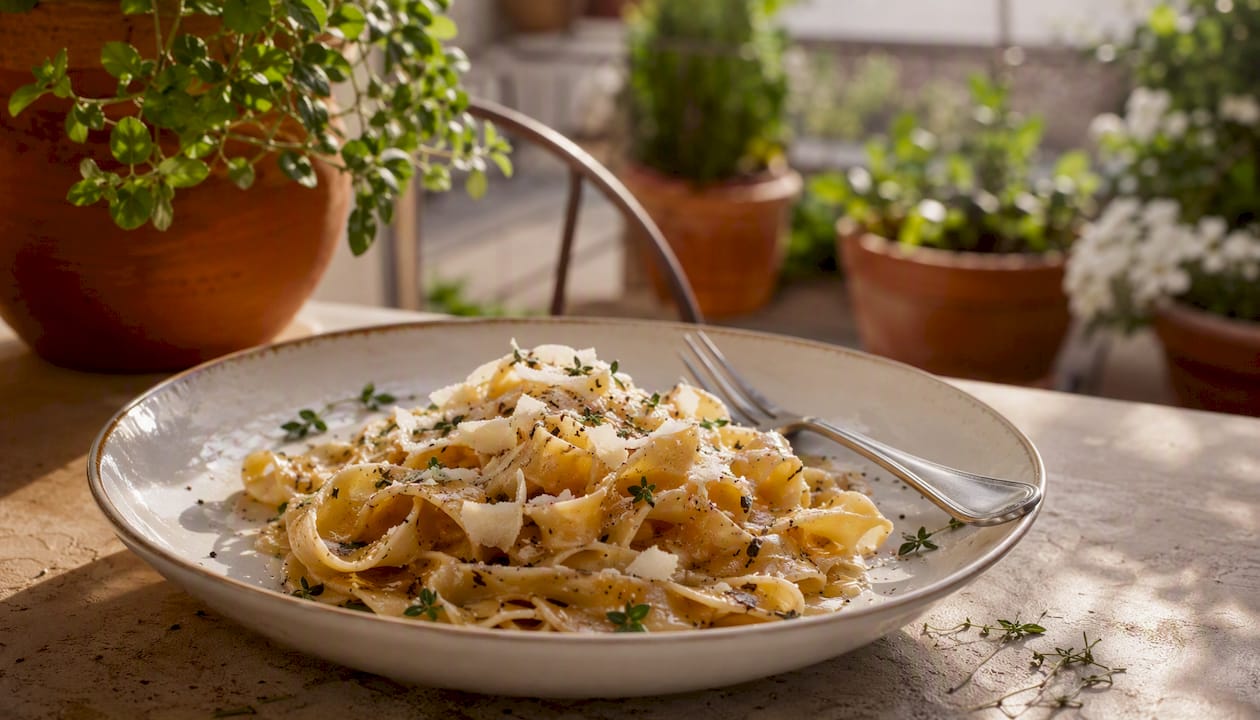
Portion around 3 to 4 ounces of fresh pasta per person, less than you’d use for dried, since fresh pasta is denser.
A Note From Forkward Kitchen’s Kitchen
We tested this recipe the way we test everything at Forkward: multiple batches, different flours, different humidity levels, until the ratio held up no matter who was rolling. It’s built for a Tuesday night, not a culinary school. If you can make a well of flour and crack two eggs into it, you can make this dough.
Once fresh pasta clicks for you, the same hands-on instincts carry over to other from-scratch projects, whether that’s artisan sourdough or laminated pastry dough. The skills stack.
Ready to put your fresh pasta to work? Forkward’s pasta recipe collection has weeknight and weekend options built around exactly this kind of homemade dough, from quick butter-and-sage plates to slow ragùs worth the wait. Browse the full recipe library for more tested, from-scratch ideas.
Frequently Asked Questions
What is the basic ratio for homemade pasta dough? Use 100 grams of flour for every large egg. A common batch is 250 g flour to 2 large eggs, plus a tablespoon of olive oil and a pinch of salt.
Can I make fresh pasta dough without eggs? Yes. A semolina and water dough, roughly 400 g semolina to 190 to 200 ml warm water, works for egg-free shapes like orecchiette and cavatelli.
How long should pasta dough rest before rolling? At least 30 minutes at room temperature, wrapped tightly. Longer rests, up to a few hours in the fridge, work too and can improve texture.
How do I know when pasta dough is kneaded enough? Press a finger into the surface. Quick spring-back and a smooth, slightly tacky feel mean it’s ready. A cross-section cut should show small, even air bubbles.
How long does fresh pasta take to cook? Thin ribbons take about 1 to 2 minutes in boiling salted water. Thicker cuts or filled shapes like ravioli take closer to 3 to 4 minutes.
Can I freeze homemade pasta dough? Freeze raw dough wrapped tightly, or freeze cut shapes flat on a tray before bagging them to prevent sticking. Cook frozen pasta directly without thawing.
Sources
- Easy Pasta Dough | Janie’s Mill
- Fresh pasta dough | Bon Appétit
- How to make pasta | BBC Good Food
- Fresh pasta recipe | King Arthur Baking