October 7, 2026
10 Quick Beginner Recipes That Build Cooking Confidence
A curated shortlist of easy, low-ingredient beginner recipes with skills-first lessons—mise en place and thermometer tips—and 10 quick templates you can...

10 Quick Beginner Recipes That Build Cooking Confidence
Start with one-pot pasta, sheet-pan dinners, simple omelets, and quick salads: these formats forgive timing mistakes, use one or two pans, and rarely call for more than six ingredients. They let you focus on technique instead of juggling multiple pots at once, which is where most new cooks lose confidence. Pick one from the shortlist below and cook it tonight.
TL;DR:
- Most beginner recipes in the article, such as one-pot pasta and sheet-pan chicken, use only a few ingredients and require minimal equipment.
- Starting with these forgiving formats helps build confidence in techniques like heat control, timing, and meal preparation without overwhelming complexity.
- Preheating pans or ovens before cooking is crucial for evenly cooked results, especially for skillet dishes and sheet-pan meals.
- Food safety relies on following basic rules of cleaning, separating, cooking to proper temperatures, and refrigerating leftovers promptly, with a thermometer being essential.
- Building skills through simple recipes allows beginners to develop muscle memory and adaptable techniques applicable across different dishes and cooking styles.
Table of Contents
- 1. A Shortlist of Foolproof Starter Recipes
- 2. Which Recipe Format Should You Learn First?
- 3. How to Start Cooking Without Mid-Recipe Panic
- 4. Food Safety Rules Every Beginner Should Know
- 5. Minimal Equipment and Pantry Staples to Start With
- 6. Ten Quick Recipe Templates to Practice This Week
- 7. How Forkward Kitchen Tests Recipes for Beginners
- 8. What I’ve Learned Watching Beginners Find Their Footing
- 9. Ready for Your Next Beginner-Friendly Recipe?
- FAQ
- Sources
1. A Shortlist of Foolproof Starter Recipes
You do not need a long list of recipes to learn how to cook well. You need a handful of forgiving ones you can repeat until they become second nature. Each of the following works across skill levels, needs minimal equipment, and recovers easily from small timing errors.
- One-pot pasta with garlic and olive oil, very easy, 20 minutes: everything cooks in a single pot, and the starchy water helps the sauce come together.
- Sheet-pan chicken thighs and vegetables, easy, 40 minutes: the oven does the work, and there’s almost no active monitoring once it’s in.
- Skillet fried rice with eggs, easy, 15 minutes: a great way to practice high-heat cooking and use up leftover rice.
- Classic three-egg omelet, easy, 8 minutes: teaches heat control and timing in a low-stakes, fast format.
- Tuna or white bean salad, very easy, 10 minutes: no cooking required, just chopping and mixing, which makes it a safe entry point for knife practice.
- Quick vegetable stir-fry, easy, 20 minutes: forces you to prep everything before turning on the heat, a habit worth building early.
- No-knead bread, moderate, a weekend project with mostly inactive rise time: a good first baking project since the dough does most of the work.
- Simple baked salmon with lemon, easy, 20 minutes: a reliable way to practice checking doneness without the complexity of a sauce.
- Basic tomato soup from canned tomatoes, very easy, 25 minutes: a confidence builder that teaches seasoning adjustment.
- Loaded baked potatoes, very easy, 45 minutes mostly hands-off: almost impossible to ruin, and flexible with toppings.
Try a tested version of one of these tonight, like our pesto pasta recipe, which keeps the ingredient list short and the cook time under 20 minutes.
2. Which Recipe Format Should You Learn First?
Different beginner recipe formats solve different cooking challenges: cleanup, timing, or ingredient complexity. Understanding how each works helps you adapt recipes instead of just following them blindly.
One-pot meals simplify sequencing because everything, including pasta or rice, cooks in the same vessel. The typical workflow is: sauté aromatics, add liquid and the main starch, simmer, then finish with cheese or herbs. Most need four to seven ingredients and one pan to wash. Our guide to easy pasta recipes walks through several variations if you want to start there.
Sheet-pan dinners work by roasting protein and vegetables together at one temperature, usually 400 to 425°F. The sequence is: chop, toss with oil and seasoning, spread in a single layer, then roast until done. Cleanup is one pan, sometimes lined with foil for zero scrubbing. Check out our sheet-pan dinner ideas for combinations that cook evenly without babysitting.
Skillet meals reward attention and movement. The workflow is: heat the pan first, add fat, then add ingredients in order of cook time, the hardest vegetables first, delicate ones last. This format teaches you to read visual and audible cues, like the sound of a sizzle slowing down.
Egg dishes are the fastest way to practice heat control because eggs go from perfect to overcooked in under a minute. Start low, remove from heat slightly before you think they’re done, and let residual heat finish the job.
Slow-cooker and Instant Pot recipes solve a different problem entirely: time management rather than technique. They’re most useful when you want dinner ready without being home to tend it, or when you’re batch cooking for the week. The tradeoff is less control over texture, which makes these formats better for stews and braises than for anything that needs a crisp finish.
Pro Tip: Preheat your pan or oven fully before adding food. A cold pan is the most common reason beginner skillet and sheet-pan dishes turn out unevenly cooked.
3. How to Start Cooking Without Mid-Recipe Panic
The biggest difference between a smooth cooking session and a stressful one is preparation before you turn on the heat. Professional cooks call this mise en place, a French term meaning “everything in its place,” and it is widely considered the single most effective habit for avoiding mid-cook scrambling.
- Read the full recipe first, start to finish, before touching an ingredient. This catches steps like “marinate for an hour” before you’re already hungry.
- Gather every ingredient and tool onto the counter so you’re not digging through cabinets mid-cook.
- Measure and chop everything called for in the first few steps before you start cooking.
- Practice three basic cuts: a rough chop for vegetables going into a pot, a die for even cooking, and a mince for garlic or herbs. Keep your knuckles curled under and the blade angled away from your fingers.
- Understand your measuring tools: a tablespoon is three teaspoons, a cup is 16 tablespoons, and baking recipes that specify weight (grams or ounces) are more accurate than volume measurements, since flour can compress differently scoop to scoop.
- Follow the recipe exactly the first time before improvising. You need a baseline to know what “right” tastes and looks like.
A quick way to build feel fast: spend 10 to 15 minutes dicing a single onion into small, medium, and large pieces, then repeat with a bell pepper. This builds muscle memory for cut sizes without the pressure of a timer running on the rest of a meal. If portion sizing feels like guesswork once you start cooking regularly, lightweight estimation methods can help you prep consistent amounts without weighing everything.
4. Food Safety Rules Every Beginner Should Know
Food safety comes down to four actions: clean, separate, cook, and chill. Skipping any one of them is how most kitchen illness happens, and an estimated 1 in 6 Americans gets sick from foodborne illness every year, with many requiring hospitalization.
- Clean: wash your hands thoroughly with soap and water before and after handling raw meat, poultry, or eggs.
- Separate: use different cutting boards for produce and raw meat to avoid cross-contamination.
- Cook: use a food thermometer rather than color or texture to confirm doneness.
- Chill: refrigerate leftovers promptly, ideally within a couple of hours of cooking, or within one hour if the room is above 90°F.
Safe minimum internal temperatures, per USDA guidance, are 165°F for all poultry and reheated leftovers, 160°F for ground meats and egg dishes, and 145°F with a three-minute rest for whole cuts of meat and most fish. The “danger zone,” the range where bacteria multiply fastest, sits between 40°F and 140°F: a simple way to remember it is “keep it cold, keep it hot, don’t let it sit in the middle.”
Thermometer placement matters as much as owning one. Insert the probe into the thickest part of the food, avoiding bone, fat, and gristle, since these conduct heat differently and give a false reading. For thin cuts like chicken breasts or pork chops, insert the thermometer through the side so the tip reaches the center. For leftovers, store them in shallow containers so they cool faster, and use them within three to four days.

5. Minimal Equipment and Pantry Staples to Start With
You don’t need a fully stocked kitchen to cook well. A short list of versatile tools covers nearly every beginner recipe.
- A chef’s knife: the one tool you’ll use in almost every recipe, for chopping, slicing, and mincing.
- A cutting board: ideally two, one for produce and one for raw meat.
- A medium pot: for pasta, rice, soups, and boiling vegetables.
- A large skillet: for sautéing, searing, and frying eggs.
- An instant-read thermometer: the only reliable way to confirm meat and poultry are safe to eat.
- Measuring cups and spoons: for consistent results until your instincts catch up.
For pantry staples, prioritize versatility over variety: olive oil, salt, black pepper, garlic, onions, canned tomatoes, canned beans, dried pasta, rice, eggs, butter, a neutral cooking oil, soy sauce, chicken or vegetable broth, flour, sugar, vinegar, a few dried herbs like oregano and basil, and frozen vegetables for when fresh produce runs out. Canned and boxed staples keep for months and cost less per serving than fresh equivalents, and freezing extra portions of cooked grains or proteins stretches a grocery budget further.
6. Ten Quick Recipe Templates to Practice This Week
These templates teach structure, not just a single dish. Swap the protein, vegetable, or starch once you understand the pattern.
- Scrambled eggs and toast: whisk two eggs, cook low and slow, 4 minutes; swap in cheese or herbs.
- One-pot pasta aglio e olio: pasta, garlic, olive oil, red pepper flakes, 20 minutes; swap in spinach at the end.
- Sheet-pan sausage and peppers: 400°F, 25 minutes; swap sausage for chicken thighs.
- Skillet fried rice: day-old rice, egg, soy sauce, 15 minutes; swap in any leftover vegetable.
- Baked salmon: 400°F, 15 to 18 minutes until it reaches 145°F internally with a three-minute rest; swap lemon for a soy-ginger glaze.
- Tuna salad sandwich: canned tuna, mayo, celery, 10 minutes; swap in Greek yogurt for the mayo.
- Vegetable stir-fry: hard vegetables first, soft ones last, 15 minutes; swap in any protein.
- Loaded baked potato: 400°F, 45 minutes; swap toppings for whatever’s in the fridge.
- Tomato soup: canned tomatoes, broth, cream, 25 minutes; swap in roasted garlic for depth.
- No-knead bread: flour, yeast, salt, water, mostly inactive rise time; swap in herbs or seeds on top.
7. How Forkward Kitchen Tests Recipes for Beginners
Recipes are developed and tested carefully to ensure the steps, timing, and ingredient lists reflect practical cooking experience rather than guesswork.
- Every recipe is labeled with an honest difficulty rating, from very easy to advanced, based on practical cooking experience rather than assumption.
- A “very easy” or “easy” label means fewer steps, minimal technique, and short active cook time, so you know what you’re getting into before you start.
- The recipes are written for everyone from first-time cooks to experienced home chefs, covering both quick weeknight meals and more involved weekend projects.
Browse our full recipe collection or read more about how we develop recipes from scratch if you want to understand the testing process behind the ratings.
8. What I’ve Learned Watching Beginners Find Their Footing
The cooks who improve fastest aren’t the most talented ones. They’re the ones who repeat a handful of simple recipes until the steps stop feeling foreign. Mistakes are part of the process, not a sign you’re doing it wrong, and a burnt onion or a dry chicken breast teaches more than a perfect one ever will.
— Oloru
9. Ready for Your Next Beginner-Friendly Recipe?
Once you’ve got a one-pot or sheet-pan dinner under your belt, our full recipe collection has honest difficulty ratings on every page, so you always know what you’re signing up for before you start cooking. Each recipe is developed and tested in our own kitchen, not pulled together from other sites, which means the steps and timing actually match what you’ll experience at home.
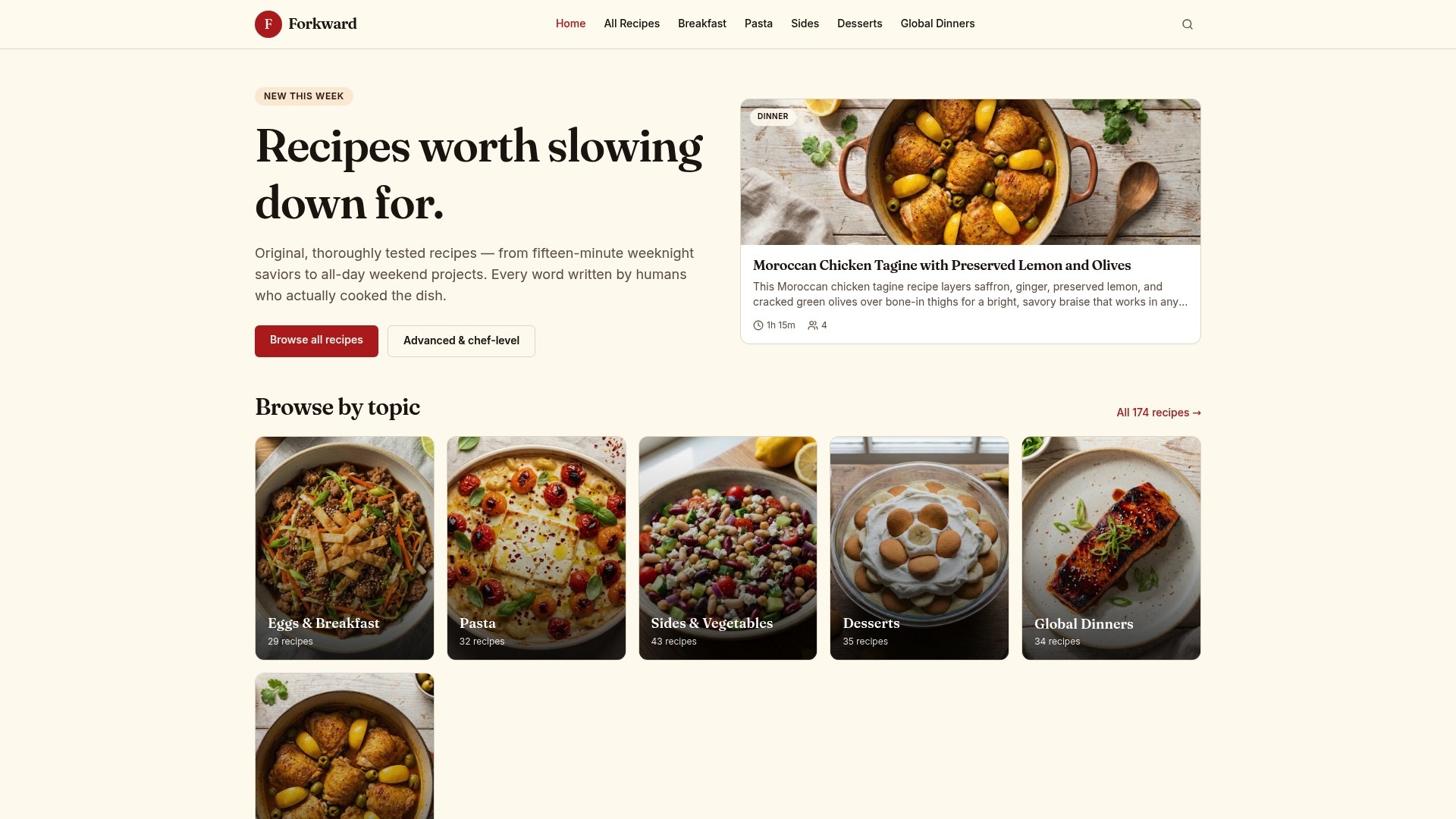
If pasta is your comfort zone, our easy pasta recipes collection is a solid next stop, with short ingredient lists and quick cook times built for weeknights. When you’re ready to push past the basics, our advanced and chef-level recipes are there waiting.
FAQ
What should I make as a beginner?
Start with one-pot pasta, sheet-pan chicken and vegetables, or a simple omelet. These formats use few ingredients, forgive small timing mistakes, and need only one or two pans.
What are some good starter meals?
Good starter meals include skillet fried rice, baked salmon, tuna salad, and loaded baked potatoes. Each takes under 45 minutes and relies on basic techniques like sautéing, roasting, or simple assembly.
What’s the easiest meal to cook?
A three-egg omelet or a tuna salad are among the easiest meals, since neither requires more than a few minutes of active cooking or advanced technique. Both also teach useful foundational skills, like heat control for eggs and knife work for salads.
How should a beginner start cooking?
Begin by reading a recipe fully before cooking, then prep and measure every ingredient first, a habit called mise en place. Practice basic knife cuts separately from a timed recipe, and use a food thermometer to confirm doneness rather than relying on color or time alone.
Do I need a food thermometer to cook safely?
Yes, a thermometer is the only reliable way to confirm meat and poultry have reached a safe internal temperature. Visual cues are unreliable, since a notable portion of hamburgers can appear brown before reaching safe internal temperatures.