July 29, 2026
Tri Ply vs 5 Ply: Which Pan Fits Your Cooking?
Discover the differences in tri ply vs 5 ply cookware. Learn which pan suits your cooking style for quick meals or lengthy braises.

Tri Ply vs 5 Ply: Which Pan Fits Your Cooking?
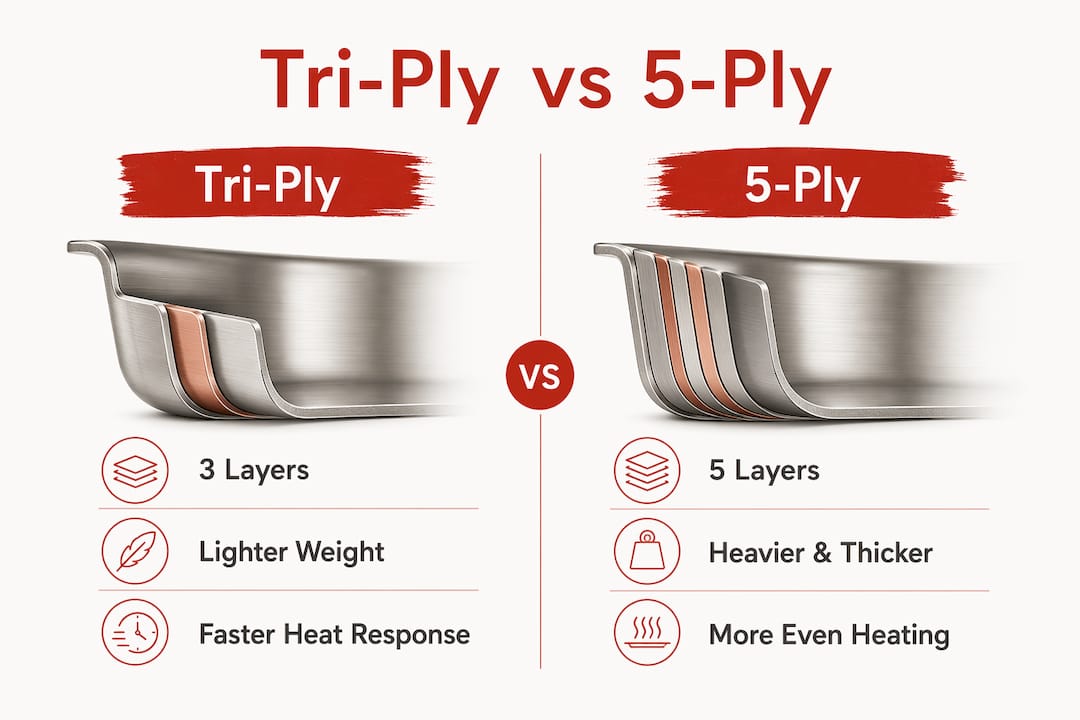
For most home cooks, tri-ply is the better default. It heats up faster, responds quickly when you turn the burner down, and weighs less than its 5-ply counterpart. Go 5-ply when you need a pan that holds steady heat through a long sear or a two-hour braise.
- Heat responsiveness: Tri-ply reacts faster to burner changes, which matters for omelets, stir-fries, and weeknight pasta sauces.
- Heat retention: 5-ply holds temperature longer, which is what you want when searing a thick steak or simmering a sauce for 45 minutes.
- Weight and handling: 5-ply pans are noticeably heavier. If you’re lifting a full sauté pan repeatedly, that difference is real.
For Forkwardkitchen recipes like quick eggs and stir-fries, tri-ply wins on agility. For advanced searing and long sauces, 5-ply earns its extra cost.
Caveat: Ply count alone doesn’t tell you how a pan actually performs. A thick 3-ply pan can outperform a thin 5-ply one. Always check published weight and core thickness for the diameter you’re buying.
Table of Contents
- How do tri ply vs 5 ply pans compare for real recipes?
- What do “tri-ply” and “5-ply” actually mean?
- Which pan should you use for common home-cooking tasks?
- What should you check before buying a pan?
- How to care for multi-ply stainless pans
- Three kitchen tests to judge any pan you already own
- The “more plies = better” myth, and what actually matters
- Forkwardkitchen has recipes built for both
- Key Takeaways
How do tri ply vs 5 ply pans compare for real recipes?
| Dimension | Tri-ply (3-ply) | 5-ply |
|---|---|---|
| Heat distribution | Even across base and sides | Even, with more thermal mass |
| Heat responsiveness | Fast | Moderate |
| Heat retention / stability | Good | Excellent |
| Weight and handling | Lighter | Heavier |
| Typical price range | varies widely depending on brand and model | typically higher than tri-ply options |
| Durability / maintenance | Excellent with proper care | Excellent; thicker core resists warping |
| Best use cases | Eggs, stir-fries, pasta sauces, sautés | Searing, braises, long simmers |
| Cladding up the sides | Yes, on full-clad models | Yes, on full-clad models |
What to match to your recipe:
- Quick temperature changes (omelets, stir-fry sauce) → tri-ply
- Sustained high heat (pan-seared steak, slow-cooked chili) → 5-ply
What do “tri-ply” and “5-ply” actually mean?
Both constructions bond multiple metal layers into a single wall. Tri-ply is stainless steel + aluminum core + stainless steel. 5-ply adds more internal layers, often a second aluminum layer or a different alloy, for additional thermal mass.
The aluminum core is the key. Aluminum conducts heat roughly 15 times better than steel, so it spreads heat evenly across the base and up the sides. When bonded layers extend up the sides, sauces and sautés heat evenly instead of scorching at the bottom while the walls stay cool.
- Tri-ply: one conductive core, lighter, faster response
- 5-ply: multiple conductive layers, more thermal mass, steadier temperature
Which pan should you use for common home-cooking tasks?
- Omelets and scrambled eggs — Tri-ply. You need to drop the heat fast; a responsive pan gives you that control.
- Weeknight stir-fries — Tri-ply. High heat, quick toss, then off the burner. Speed matters more than retention here.
- Pasta sauces — Tri-ply works well for most. Check the pasta recipes on Forkwardkitchen for weeknight skillet sauces that come together in under 20 minutes.
- Pan-seared steak — 5-ply. A thick steak drops pan temperature fast; you need a pan that recovers and holds.
- Long braises and stews — 5-ply. The Forkwardkitchen slow cooker pulled pork shows what steady, sustained heat does for connective tissue. A heavy 5-ply skillet delivers that on the stovetop.
- Delicate fish fillets — Tri-ply. You want precise, adjustable heat, not a pan that keeps cooking after you lower the flame.
On ergonomics: A 12-inch 5-ply skillet full of vegetables is heavy. If you cook solo or have wrist fatigue, a quality tri-ply in a 10-inch size often does the same job with less strain.
What should you check before buying a pan?
- Published weight for the diameter (a 10-inch skillet should feel substantial, not flimsy)
- Core thickness in mm, if listed — this matters more than ply count
- Full-clad vs. encapsulated base — full-clad means the layers run up the sides; encapsulated means only the bottom is bonded
- Handle attachment — riveted handles outlast welded ones for daily use
- Base flatness — a warped base creates hot spots on flat-top and induction burners
- Induction compatibility — check the outer layer is magnetic stainless
- Warranty — reputable brands like All-Clad D3 and Demeyere Industry back their pans with long warranties
Price expectations: Reliable tri-ply (Cuisinart Multiclad Pro, Tramontina Tri-Ply Clad) starts around $30–$60 per piece. Quality 5-ply (Misen, Demeyere Industry) typically runs $80–$200+. Heritage Steel sits in the upper-middle range with American-made construction.
Pro Tip: Check whether “5-ply” in a product listing means full-clad or just an encapsulated base with extra layers. Only full-clad construction heats the sides evenly.
How to care for multi-ply stainless pans
- Preheat before adding oil. Medium heat for 2–3 minutes. Drop a few water droplets — if they bead and roll (the Leidenfrost effect), the pan is ready.
- Don’t overheat. Stainless doesn’t need screaming-high heat. Medium-high is enough for most searing.
- Deglaze stuck fond with a splash of water or wine while the pan is still warm. Most residue releases immediately.
- Hand wash when possible. Dishwashers won’t ruin a quality clad pan, but repeated cycles dull the finish and can loosen handle rivets over time.
- No cold water on a hot pan. Thermal shock can warp even a well-made pan. Let it cool before washing.
- Store with pan protectors or a towel between stacked pans to prevent scratches on the cooking surface.
Three kitchen tests to judge any pan you already own
- Water bead test (responsiveness): Heat the pan on medium. Flick a few drops of water in. If they bead and skitter, the pan is at the right searing temperature. A pan that takes forever to reach this point has poor responsiveness — a tri-ply issue to watch for in cheaper models.
- Butter browning test (evenness): Melt a tablespoon of butter over medium heat and watch where it browns first. Even browning across the whole surface means the cladding is doing its job. Dark spots at the center only signal a base-only construction.
- Sear-and-rest test (retention): Sear a thick chicken thigh, then lift it. Does the pan temperature drop sharply? A pan with good retention holds steady; a thin pan cools fast and the next piece of protein steams instead of sears.
Run these during a normal cook. The stir-fry sauce recipe on Forkwardkitchen is a good responsiveness test — it requires quick heat adjustments at multiple stages.
The “more plies = better” myth, and what actually matters
More layers do not automatically mean better cooking. Some 5-ply pans add internal stainless layers to change material composition rather than improve heat transfer. A well-made 3-ply pan with a thicker aluminum core can outperform a thin 5-ply pan in both responsiveness and evenness.
- Myth: 5-ply is always hotter and better for searing. Reality: Heat stability depends on total mass and core thickness, not layer count.
- Myth: More plies means a thicker pan. Reality: A 5-ply pan can be thinner overall than a 3-ply pan with a generous core.
- Myth: Ply count predicts durability. Reality: Bonding quality, stainless gauge, and how you treat the pan matter far more.
Focus on core thickness, total pan mass for the diameter, and whether the cladding runs to the rim. Those three specs tell you more than any ply number on the box.
Forkwardkitchen has recipes built for both
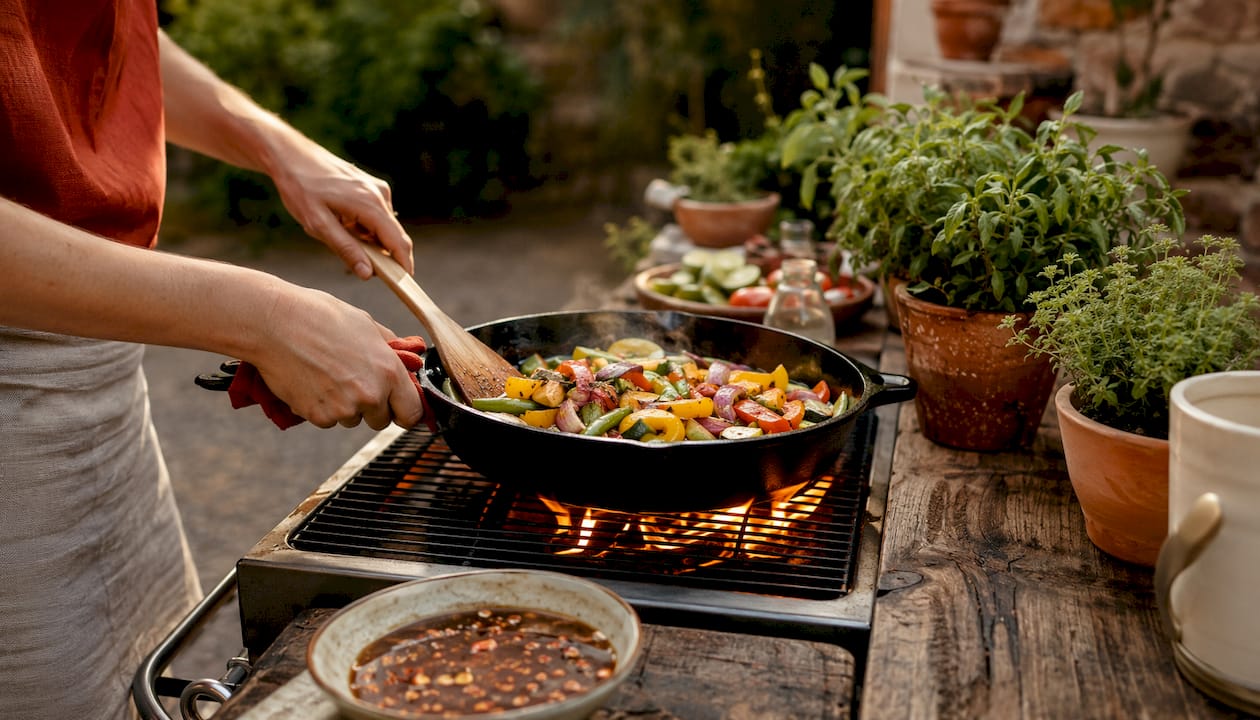
You picked your pan. Now cook something worth eating. Forkwardkitchen’s full recipe index covers the whole range: quick weeknight eggs and stir-fries that reward a responsive tri-ply, and slow-built sauces and sears that show off what a heavier 5-ply can do. Every recipe is tested from scratch with honest difficulty ratings, so you know exactly what you’re getting into before you turn on the burner.
Browse the all recipes page and filter by technique or difficulty to find your next cook.
Key Takeaways
For most home cooks, tri-ply is the smarter starting point: it’s lighter, faster to respond, and covers the majority of everyday recipes without the weight penalty of 5-ply.
| Point | Details |
|---|---|
| Tri-ply for speed | Tri-ply heats faster and responds quicker, making it ideal for eggs, stir-fries, and weeknight pasta. |
| 5-ply for stability | 5-ply holds heat longer, which benefits searing thick cuts and long simmering tasks. |
| Ply count isn’t everything | Core thickness and total pan mass predict performance better than the number of layers. |
| Check full-clad construction | Layers that run up the sides heat sauces evenly; base-only cladding leaves side walls cooler. |
| Forkwardkitchen recipes | Forkwardkitchen’s tested recipe index pairs specific techniques with the pan behavior that suits them best. |