September 7, 2026
3 Ways Home Cooks Make Confit Garlic, Plus Safe 1–2 Weeks Storage
Three tested methods to make jammy confit garlic—stovetop, oven, slow cooker—with safety-first cooling and 1–2 week fridge storage guidance.
3 Ways Home Cooks Make Confit Garlic, Plus Safe 1–2 Weeks Storage
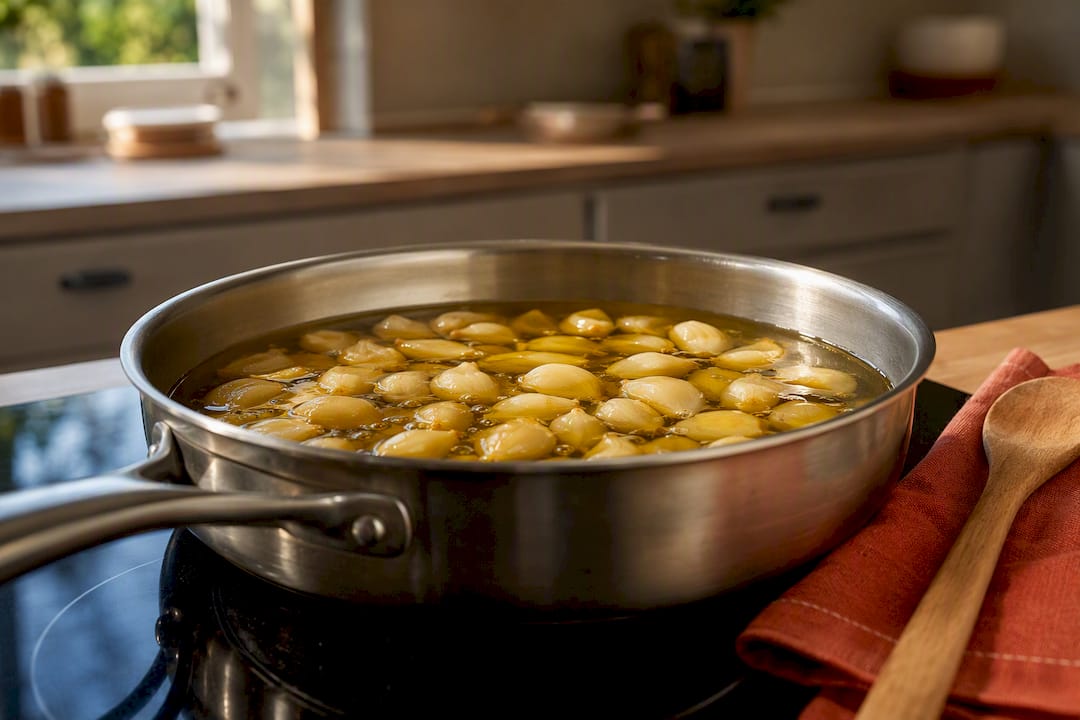
Confit garlic is whole peeled cloves cooked low and slow in oil until they turn soft enough to mash with a fork, sweet instead of sharp, and completely spreadable. You end up with two ingredients in one pot: jammy garlic for toast and sauces, plus a garlic-infused oil for finishing anything from roasted vegetables to vinaigrette. You can make it on the stovetop, in the oven, or in a slow cooker, and the safety rules for storing it matter just as much as the cooking method.
TL;DR:
- Using olive oil will impart a firmer, fruitier flavor, while neutral oils like grapeseed allow the garlic’s sweetness and depth to shine.
- Confit garlic stored at room temperature poses a botulism risk, and refrigeration is essential for safety, limiting storage to one to two weeks.
- The oven method at around 210°F produces the most evenly cooked and soft garlic, with stovetop being faster but requiring close attention to avoid burning.
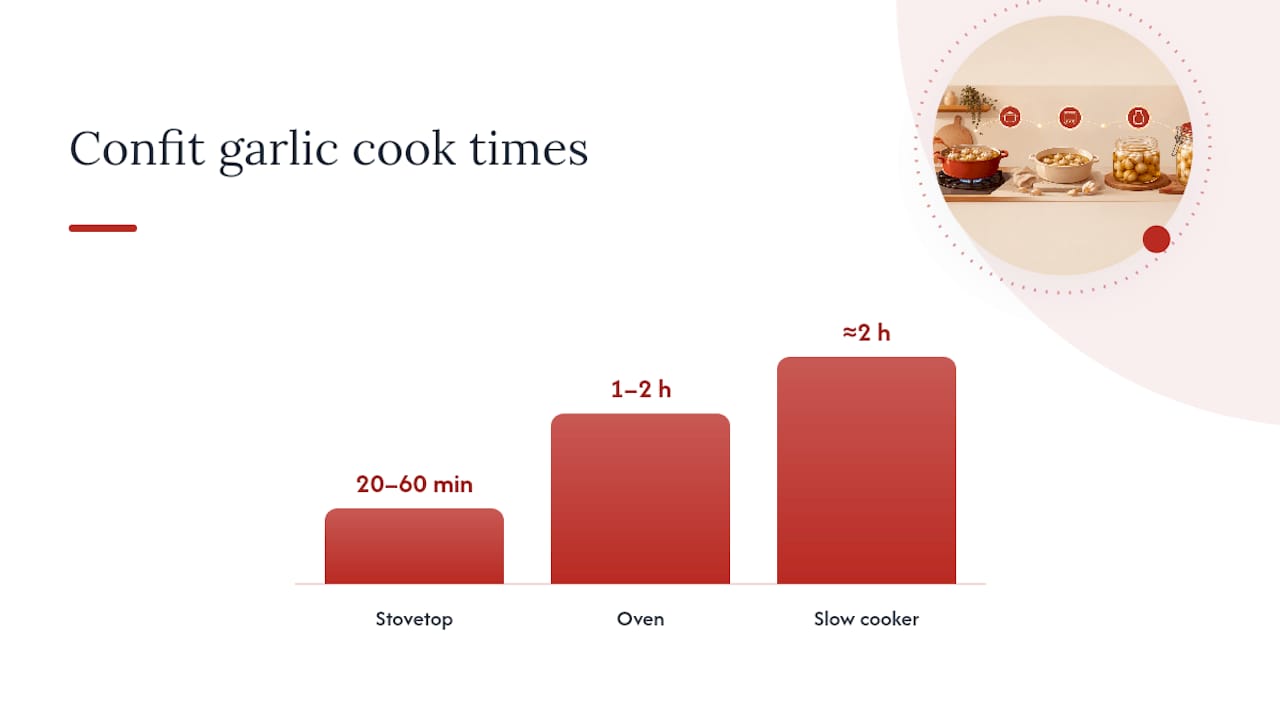
- Cooking time varies from 20 to 60 minutes on the stovetop, 1 to 2 hours in the oven, and about 2 hours in a slow cooker, depending on batch size and temperature.
- Frozen garlic cubes thaw in 10 to 15 minutes and are ideal for quick use, but long-term shelf stability requires pressure canning.
Table of Contents
- What Is Garlic Confit, Exactly?
- Ingredients and Tools You’ll Need
- How Do You Make Confit Garlic?
- How Long Does Confit Garlic Last, and Is It Safe?
- What Can You Make With Confit Garlic?
- Flavor Variations and Common Fixes
- What We Learned Testing Three Methods Side by Side
- Why I Keep a Jar of This in the Fridge
- Ready to Put That Jar to Work?
- Sources
What Is Garlic Confit, Exactly?
“Confit” is a French preservation technique that predates refrigeration: submerge food in fat and cook it gently until it softens and takes on the flavor of that fat. Duck confit uses duck fat. Garlic confit uses oil, and it’s a far quicker project since cloves cook through in an hour or two instead of a day.
The result is nothing like raw garlic. Low heat mellows the sharp, sulfurous bite you get from a raw clove and leaves behind something closer to roasted garlic, but silkier and more spreadable. Cooking garlic this way also breaks down allicin, the compound responsible for raw garlic’s punch, while keeping most of the fat-soluble flavor compounds intact, according to Everyday Health. That’s the trade-off: less of the sharp bite, more sweetness and depth.
Ingredients and Tools You’ll Need
A standard batch runs about 3 heads of garlic, peeled, to roughly 1.5 cups of oil, enough to fully submerge the cloves according to guidance from Michigan State University Extension. Scale that ratio up or down, but don’t skimp on oil. Cloves that peek above the surface brown unevenly and can scorch before the rest of the batch is done.
Oil choice changes the outcome. Extra-virgin olive oil brings a fruitier, more assertive flavor that can dominate delicate dishes, while a neutral oil like grapeseed or avocado lets the garlic itself take center stage, a trade-off Bon Appétit notes explicitly. Either works. Pick based on how you plan to use the finished oil.
What you’ll want on hand:
- A heavy-bottomed saucepan (stovetop) or a small ovenproof braiser or a baking dish (oven)
- A slow cooker if you’re going hands-off
- An instant-read thermometer to keep tabs on oil temperature
- A slotted spoon for lifting cloves without breaking them
- Clean, sterilized jars for storage
Pro Tip: Peel a whole head fast by smashing it lightly with the flat of a knife, then rolling the cloves under a bowl on the counter. The skins slip right off without any picking.
How Do You Make Confit Garlic?
All three methods rely on the same principle: low, steady heat and fully submerged cloves. Pick whichever fits your schedule and your kitchen setup, based on testing approaches documented by What’s Gaby Cooking.
- Stovetop. Add peeled cloves and oil to a small, heavy pan, set the burner to its lowest setting, and bring the oil to a bare simmer, just a few lazy bubbles, not a rolling boil. Cook for 20 to 60 minutes depending on your stove and how large the cloves are, stirring occasionally so nothing sticks to the bottom. Test doneness by pressing a clove against the side of the pan with a spoon. If it mashes easily, it’s done.
- Oven. Preheat to somewhere between 210°F and 250°F (100°C to 120°C). Lower temperatures around 210°F are gentler and more forgiving, giving you uniformly jammy cloves without the harsher browning that creeps in near the top of that range, according to testing from Bon Appétit. Use a small, deep baking dish rather than a wide shallow one. A tall, narrow vessel concentrates the oil and keeps cloves fully covered, per What’s Gaby Cooking. Bake for 1 to 2 hours, checking at the 45 minute mark and every 15 to 20 minutes after that.
- Slow cooker. Cover cloves with oil and set to LOW. Most batches are done in about 2 hours, but check earlier if your slow cooker runs hot. Residual heat keeps cooking the cloves even after you switch it off, so pull them slightly before they look fully done if you’re leaving them in the crock.
A few troubleshooting notes worth keeping in your back pocket: if the oil starts bubbling aggressively on the stovetop, your heat is too high, drop it down immediately. If cloves brown faster than they soften, your oven or burner is running hotter than the dial suggests, and a thermometer will save you from guessing. Batch size matters, too. Doubling a recipe in the same vessel usually means adding 15 to 20 minutes, since the extra volume takes longer to come up to temperature evenly.
Pro Tip: Don’t walk away for more than 15 minutes at a time on the stovetop. Confit garlic goes from perfectly jammy to burnt shockingly fast once the oil creeps past a simmer.
How Long Does Confit Garlic Last, and Is It Safe?
Garlic stored in oil at room temperature is a genuine botulism risk. Clostridium botulinum spores thrive in low-oxygen, low-acid environments, exactly what a jar of submerged garlic cloves provides, and the World Health Organization flags this as a known hazard for oil-packed garlic and vegetables. Refrigeration below about 38°F slows toxin production, which is why cooling and cold storage aren’t optional steps here, they’re the whole safety plan.
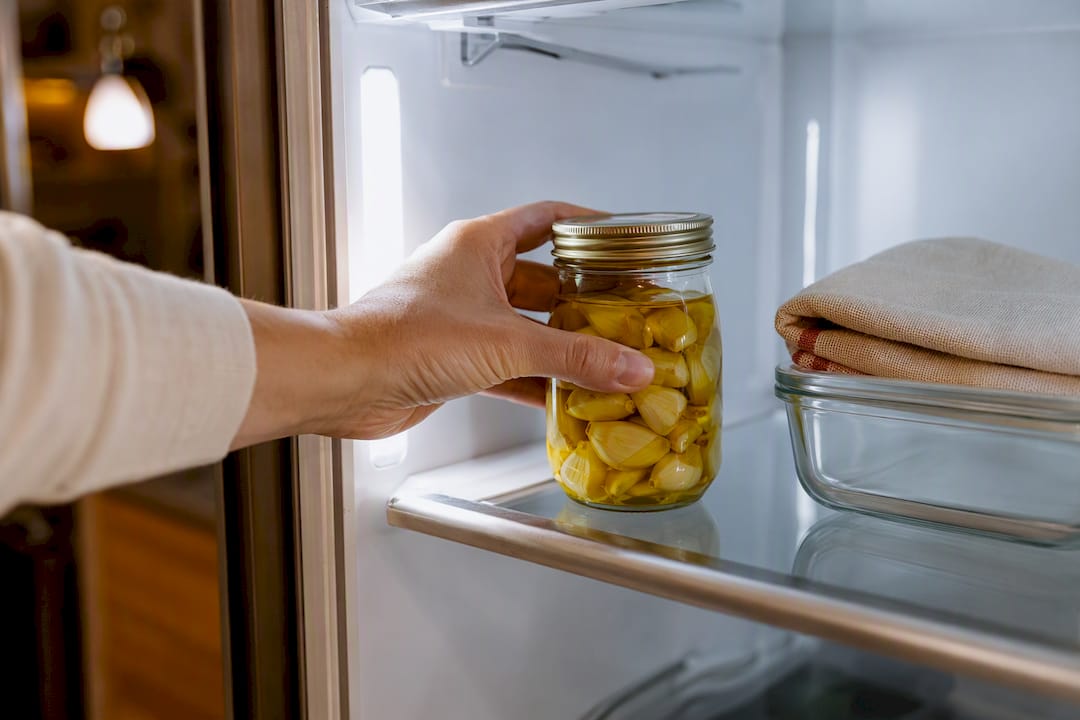
After cooking, cool the garlic and oil quickly rather than leaving it on the counter. An ice bath under the jar speeds this along and cuts down the time your batch spends in the temperature danger zone, a practical tip highlighted by Serious Eats. Once cooled, transfer to a clean, sterilized jar and refrigerate right away.
For storage windows:
- Refrigerator: Use within 1 to 2 weeks, a conservative window recommended by Bon Appétit.
- Freezer: Portion cloves and oil into an ice-cube tray and freeze for up to 3 months, giving you single-use portions ready to drop into a pan.
- Long-term shelf-stable storage: Not achievable through casual refrigeration alone. Serious Eats notes that pressure canning is the only reliable home method for shelf-stable, long-term preservation.
Discard anything that smells off, looks cloudy or discolored beyond the usual light golden hue, or has been sitting at room temperature for more than an hour or two after cooking.
What Can You Make With Confit Garlic?
Once you’ve got a jar in the fridge, the uses stack up fast. The cloves themselves are soft enough to spread straight from the jar, and the oil is arguably the more versatile half of the batch.
- Mash cloves onto warm, crusty bread or crostini as a simple appetizer.
- Fold mashed cloves into softened butter for a garlic butter that’s miles better than the raw version, the kind of thing that makes sourdough garlic bread genuinely memorable.
- Stir cloves into mashed potatoes in place of raw garlic for a sweeter, mellower side dish, especially good tucked into crispy smashed potatoes.
- Blend a few cloves into aioli, dressings, or pan sauces for instant depth.
- Use the infused oil as a finishing oil over roasted vegetables, or swap it in for plain oil when pan-frying.
- Drop a spoonful of cloves and oil into a simmering pot of tomato basil soup for a richer base.
Frozen cubes thaw fast at room temperature, usually within 10 to 15 minutes, so you can pull exactly what you need for a single dish without defrosting the whole batch.
Flavor Variations and Common Fixes
Confit garlic is forgiving once you know the basic ratios, and it takes well to add-ins. Toss in a couple of sprigs of thyme or rosemary, a bay leaf, or about a teaspoon of red chile flakes per batch for a spicier, herbier oil. Swapping neutral oil for extra-virgin olive oil shifts the flavor toward fruitier and more assertive, while a neutral oil keeps the garlic itself front and center.
- If cloves brown too much before softening, they’re still usable as a flavoring stirred into a hot dish, but treat them as a one-time-use ingredient rather than something to store long-term.
- If cloves are still firm after your target time, extend the cooking on low heat in 10 to 15 minute increments rather than raising the temperature.
- If the oil starts bubbling, drop the heat immediately. A confit should barely simmer, not boil.
- For freezing, portion into ice-cube trays before the cloves fully cool. This keeps texture intact better than freezing a whole jar at once.
Pro Tip: If you’re not sure your oven runs true to its dial, stick a thermometer in with the dish. A 20-degree swing is common in home ovens and it’s the difference between jammy and browned.
What We Learned Testing Three Methods Side by Side
Running the same batch of garlic through stovetop, oven, and slow cooker versions, using both small and large batch sizes and both olive and neutral oils, turned up a consistent pattern: lower and slower always beats faster and hotter.
The oven method around 210°F produced the most even color and the softest texture across every batch size we tried. Stovetop was fastest but needed the most attention, since even a slight bump in heat pushed cloves toward browning before they’d fully softened.
The takeaway for home cooks: if you only remember one thing, remember that confit garlic should never see a real boil, in any method.
Why I Keep a Jar of This in the Fridge
I make a batch whenever I’m already peeling garlic for something else, since the extra ten minutes of prep pays off for weeks. My go-to move is mashing a few cloves into softened butter for weeknight garlic bread. This isn’t a hard recipe. It’s slow, but slow doesn’t mean difficult, and the margin for error is wider than most people expect.
— Oloru
Ready to Put That Jar to Work?
Recipes are built from scratch and tested in a real kitchen before publication, so readers are not guessing whether a technique like this actually holds up outside a photo shoot. That same approach applies whether you’re making a first batch of confit garlic or tackling something more involved on a slow weekend.
If batch cooking for the week is on your radar, the seasonal meal-prep ideas from Wild Foodz pair well with a jar of confit garlic already in the fridge, since half the flavor work is done before you even start cooking. For more recipes built around techniques like this one, browse the full recipe collection, and once you’ve got the basics down, the advanced recipe index has plenty of next steps worth bookmarking for a weekend project.
Sources
- Stinking facts about garlic | Michigan State University Extension
- Botulism — WHO
- Garlic Confit Recipe | Bon Appétit
- Garlic Confit Recipe | Serious Eats
- How To Make Garlic Confit - What’s Gaby Cooking