September 5, 2026
Home Cooks' Chicken Thigh Marinade That Needs No Adjustments
Forkwardkitchen tested chicken thigh marinade that needs no changes for grill, oven, or broiler. Simple ingredients; marinate 2 to 6 hours.
Home Cooks’ Chicken Thigh Marinade That Needs No Adjustments
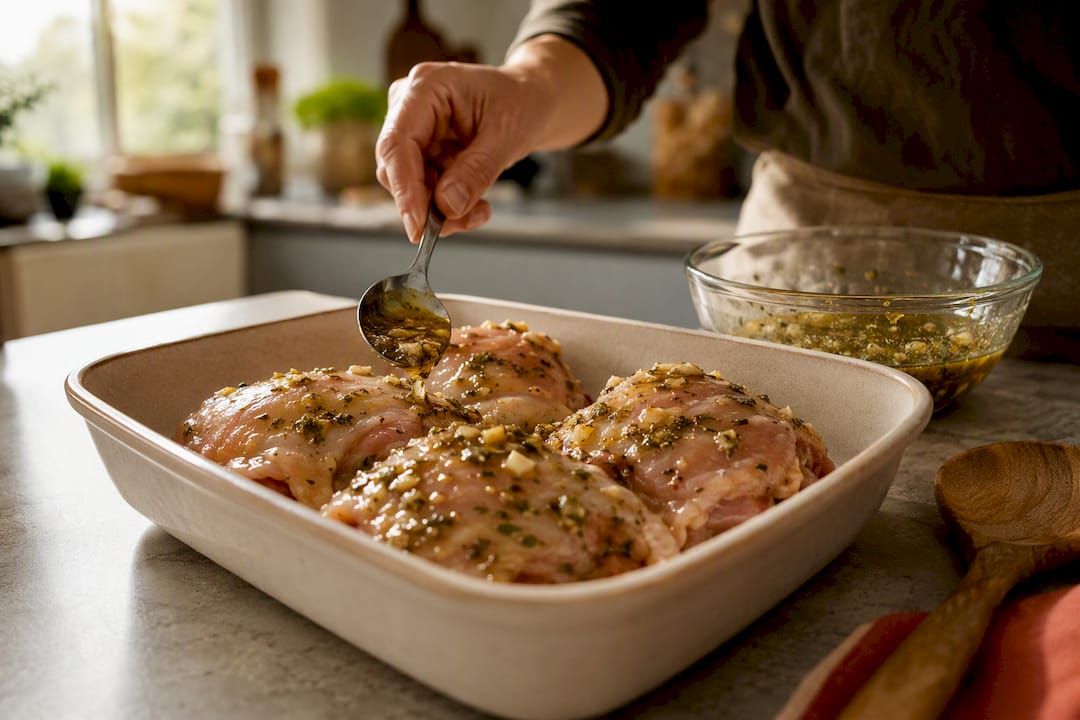
The best chicken thigh marinade is a simple mix of olive oil, lemon juice, soy sauce, honey, Dijon mustard, and garlic. It works on the grill, in the oven, or under the broiler with no adjustments to the marinade itself. Marinate for 2 to 6 hours, cook until the internal temperature reaches the safe minimum, and the method details below cover grilling, baking, and broiling times.
TL;DR:
- Marinate chicken thighs for 2 to 6 hours to achieve optimal flavor penetration without risking texture degradation from lemon acidity.
- Pat the chicken dry before marinating and use a thermometer to ensure internal temperature reaches 165°F before serving.
- Use a medium-high grill, oven at 425°F, or broiler on high with skin-side up, adjusting cooking times based on bone-in or boneless cuts.
- Flavor variations like soy-honey-ginger or mustard-maple can be made by swapping ingredients, but the basic marinade’s balance remains essential.
- Store raw marinade in the fridge for up to a week and cooked chicken for 3 to 4 days, with freezing up to 4 months for leftovers.
Table of Contents
- The Best Chicken Thigh Marinade Recipe
- How to Marinate Chicken Thighs the Right Way
- What Internal Temperature and Cook Time Should You Target?
- Grill, Bake, or Broil: Method-by-Method Instructions
- Flavor Swaps and Quick 3-Ingredient Marinades
- Storage, Make-Ahead, and Leftovers
- How Forkwardkitchen Tested This Marinade
- Why One Marinade Is Enough (And What Most Recipes Get Wrong)
- Sources
The Best Chicken Thigh Marinade Recipe
This marinade is built to do one job well across three cooking methods, and it does that because every ingredient earns its place. It’s loosely based on the classic oil, lemon, honey, Dijon, soy, and garlic combination popularized by NYT Cooking, adjusted for chicken thighs specifically since they tolerate bolder flavor and longer marinating than chicken breast.
Here’s what you need for about 2 pounds of chicken thighs, roughly 6 pieces, bone-in or boneless:
- 1/3 cup olive oil
- 1/4 cup fresh lemon juice (about 2 lemons), plus zest of one lemon
- 3 tablespoons soy sauce
- 2 tablespoons honey
- 1 tablespoon Dijon mustard
- 4 garlic cloves, minced or grated
- 1 teaspoon dried oregano or fresh thyme
- 1/2 teaspoon black pepper
- 1/2 teaspoon salt (skip or reduce if using regular soy sauce, since it’s already salty)
Whisk everything together in a bowl, or shake it in a jar with a lid. That’s the whole recipe. Double it if you’re cooking for a crowd or want extra for basting.
Every component in this list is doing specific work, not just adding flavor for flavor’s sake. The oil, acid, salt, aromatics, and sugar structure is the backbone of nearly every good marinade you’ll ever make, chicken or otherwise:
- Fat (olive oil) coats the meat, carries fat-soluble flavor compounds from the garlic and herbs, and keeps the surface from drying out during high-heat cooking.
- Acid (lemon juice) brightens the flavor and softens surface proteins slightly, though it does very little to actually “tenderize” the interior of the meat, despite the popular myth.
- Salt and umami (soy sauce) season the meat at a deeper level than salt alone and add savory depth that plain table salt can’t replicate.
- Aromatics (garlic, herbs) deliver the flavor most people associate with a marinade in the first place.
- Sugar (honey) helps the surface caramelize and brown, particularly under the broiler or on a hot grill grate, where a plain oil-and-acid marinade tends to look pale.
If you’re avoiding soy, tamari or coconut aminos swap in at the same ratio. Maple syrup works in place of honey if you want a slightly less floral sweetness, and any neutral oil, avocado or grapeseed, can replace olive oil if you’re worried about it solidifying in the fridge, which pure olive oil sometimes does when chilled. If that happens, let the jar sit at room temperature for about 20 minutes and it will re-liquefy without any loss of flavor.
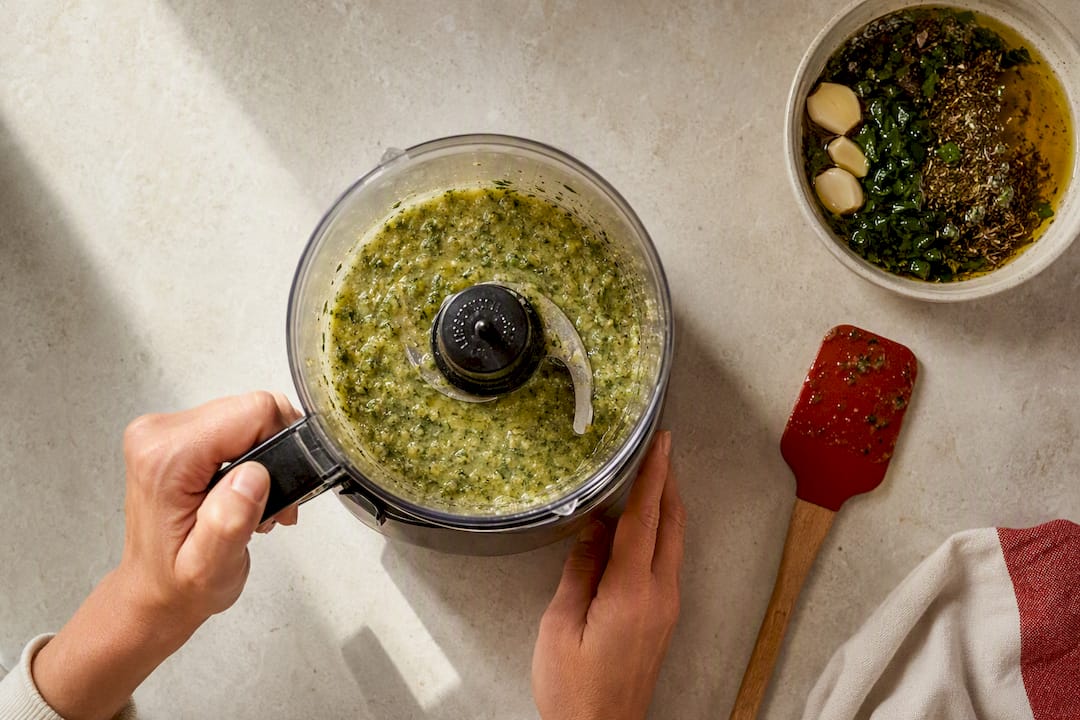
For a deeper, more evenly distributed garlic and herb flavor, blend or puree the aromatics into the marinade instead of just mincing them by hand. It sounds like a small step, but it noticeably changes how far the flavor travels into the meat.
How to Marinate Chicken Thighs the Right Way
Getting the technique right matters just as much as the recipe itself. Skip the prep steps and even a great marinade won’t fully do its job.
- Trim the thighs. Cut away any large pockets of excess fat, but leave the skin on if you’re using skin-on thighs. Excess fat renders out anyway and doesn’t need to be marinated.
- Pat the chicken completely dry with paper towels before it touches the marinade. This might sound backward, but a dry surface actually helps the marinade adhere better instead of sliding off a wet, slippery piece of chicken.
- For skin-on thighs, work some marinade under the skin. Gently slide two fingers between the skin and the meat to loosen it, then spoon a thin layer of marinade directly onto the flesh before letting the skin fall back into place. This flavors the meat where it matters most and helps the skin crisp from the inside out.
- Use a resealable bag or a shallow bowl. A bag lets you press out the air and get the marinade into full contact with every surface, which is more efficient than a bowl if you’re short on marinade. A bowl works fine too, just turn the pieces halfway through.
- Refrigerate, never leave it on the counter. Bacteria multiply fast at room temperature, so the marinating chicken belongs in the fridge the entire time.
On timing: 30 to 60 minutes gives you surface-level flavor, which is fine on a weeknight when you’re in a hurry. Two to six hours is the sweet spot for real flavor penetration without changing the texture. You can push it to 24 hours, but not much further, since the lemon juice in this marinade will start breaking down the meat’s texture past that point, leaving it slightly mushy instead of tender.
Pro Tip: If you plan to baste the chicken while it cooks, set aside a separate portion of the marinade before it ever touches raw chicken. Anything that has been sitting with raw poultry needs to be boiled first before it goes anywhere near cooked food, or it gets discarded entirely.
What Internal Temperature and Cook Time Should You Target?
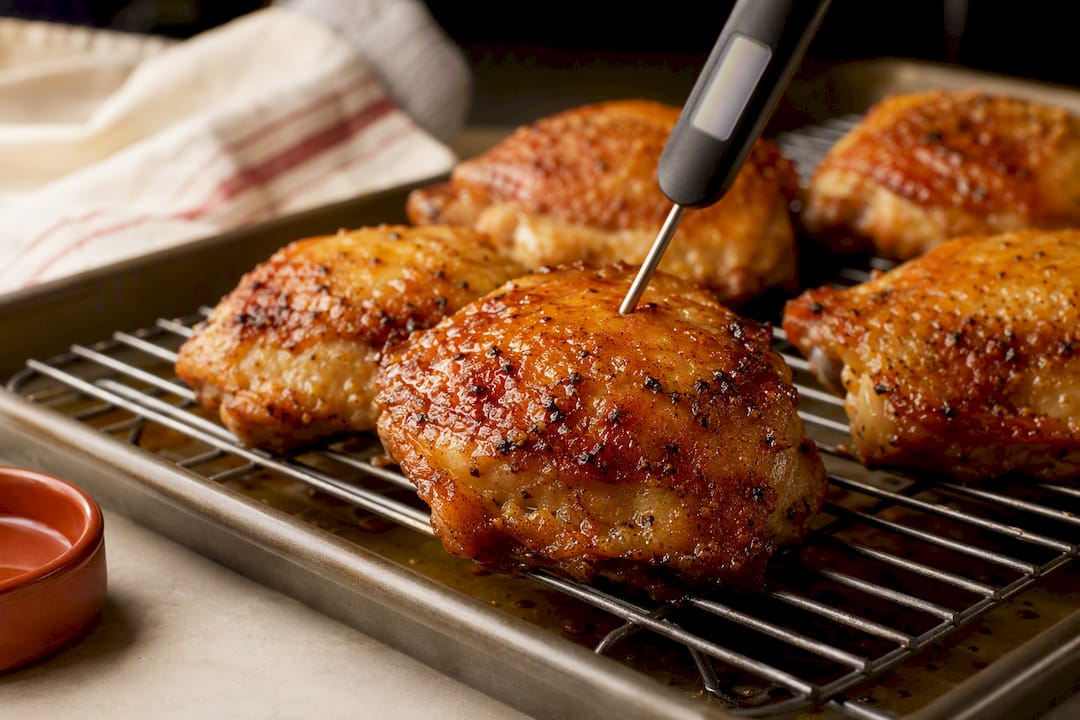
Chicken thighs are safe to eat once they hit an internal temperature of 165°F (74°C) at the thickest part, measured with an instant-read thermometer. That’s the same standard the USDA’s Food Safety and Inspection Service sets for all cooked chicken, and it’s non-negotiable regardless of cooking method.
Here’s roughly how long that takes depending on how you’re cooking:
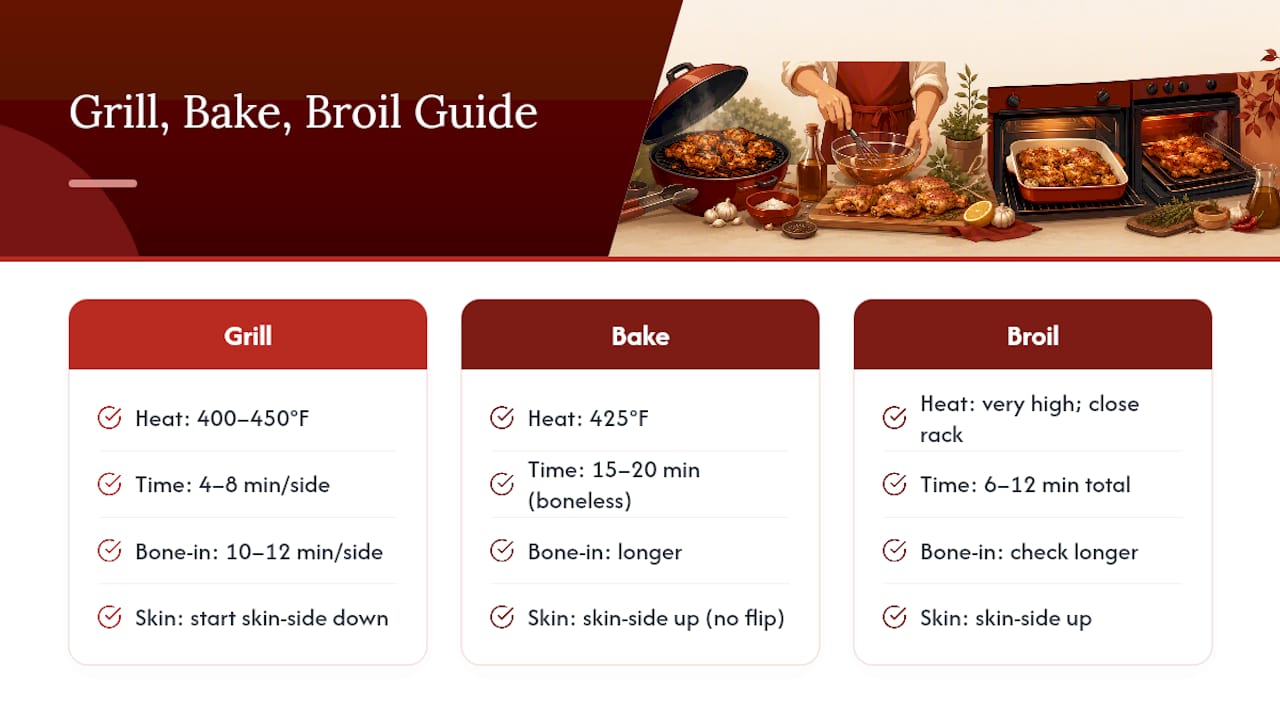
| Method | Temperature | Approximate time |
|---|---|---|
| Grilling (medium-high) | 400 to 450°F | 4 to 8 minutes per side |
| Baking | 425°F | 15 to 20 minutes |
| Broiling | High/broil setting | 6 to 12 minutes, watched closely |
Those ranges from FSIS assume boneless, skin-on thighs of average size. Bone-in thighs run longer on every method since bone conducts heat more slowly than muscle, so always confirm with a thermometer rather than trusting the clock alone.
Thighs tend to remain juicy even if cooked beyond the safe minimum temperature of 165°F, due to their higher fat content. It’s advisable to let them rest several minutes after cooking to allow juices to redistribute. Carryover cooking will nudge the internal temperature up another few degrees while the juices redistribute, so resting isn’t optional if you want a moist result.
Grill, Bake, or Broil: Method-by-Method Instructions
The marinade doesn’t change. What changes is how you manage heat, timing, and browning for each setup.
Grilling
Preheat the grill to medium-high, around 400 to 450°F, and oil the grates well so the skin doesn’t tear when you flip it. Place skin-side down first over direct heat and cook 4 to 8 minutes per side, depending on thickness, until the skin is deeply golden and the meat releases easily. If you get flare-ups from marinade dripping onto the flame, move the pieces to indirect heat briefly to calm things down, then finish over direct heat for a final char. Bone-in thighs need closer to 10 to 12 minutes per side and should be checked with a thermometer before assuming they’re done.
Baking
Preheat the oven to 425°F and set the thighs skin-side up on a rimmed baking sheet, spaced out so hot air circulates around each piece instead of steaming them. Bake for 15 to 20 minutes for boneless thighs, longer for bone-in, and resist flipping them at all, since skin-side up is what gets you crisp skin. If the skin isn’t as browned as you want by the time it hits temperature, switch the oven to broil for the last 2 to 3 minutes to finish it off. This high-heat oven approach is commonly used for baked thigh recipes.
Broiling
Position the rack about 6 inches from the broiler element and set thighs skin-side up on a broiler pan or a wire rack over a baking sheet, which lets fat drip away instead of pooling. Broil for 6 to 12 minutes, checking every couple of minutes since broilers run hot and unevenly. If you want extra-crispy skin, score it lightly before cooking so fat renders out faster. Forkwardkitchen’s broiler-charred butter chicken thighs use this same close-watch approach.
Skinless thighs cook slightly faster on all three methods since there’s no fat layer insulating the meat, so start checking temperature a couple of minutes earlier than the ranges above.
Flavor Swaps and Quick 3-Ingredient Marinades
Once you understand why this marinade works, you can bend it in a dozen directions without breaking anything.
A few execution details make a bigger difference than people expect. Pat the chicken dry again right before it hits the heat, even after marinating, since a dry surface browns and crisps far better than a wet one. Let cooked thighs rest for 5 minutes before slicing so the juices settle instead of running out onto the cutting board. And if you pulled the chicken straight from the fridge to marinate, give it 10 to 15 minutes at room temperature before cooking so it cooks more evenly from edge to center.
For flavor variations, try swapping the base marinade for one of these:
- Soy-honey-ginger: swap lemon for rice vinegar, add fresh grated ginger, keep the honey.
- Mustard-maple: double the Dijon, swap honey for maple syrup, drop the soy.
- Lemon-herb: skip the soy entirely, load up on fresh rosemary and thyme, add extra lemon zest.
- Smoky spice: add smoked paprika, cumin, and a pinch of cayenne to the base recipe.
If you want something even faster, a 3-ingredient marinade gets the job done in a pinch:
- Fast and neutral: olive oil, lemon juice, minced garlic.
- Sweet and sticky: soy sauce, honey, garlic, which pairs especially well with a skillet finish like Forkwardkitchen’s honey garlic thighs.
- Tangy and bright: plain yogurt, lemon juice, and a spoon of cumin, which also tenderizes slightly thanks to the yogurt’s mild acidity.
Pro Tip: Bone-in thighs benefit from marinating on the longer end of the range, since the bone and thicker meat take more time to absorb flavor than boneless cuts do.
Storage, Make-Ahead, and Leftovers
The uncooked marinade keeps in the fridge for up to a week in a sealed jar, though the lemon flavor fades slightly after a few days. Marinated raw chicken should go into the fridge immediately and get cooked within 24 hours, in line with the acid-based texture limit covered earlier.
- Cooked chicken keeps 3 to 4 days in the refrigerator in a sealed container.
- Freezing works well for up to 4 months; thaw overnight in the fridge rather than on the counter.
- Reheating is best done low and covered, around 300°F in the oven for 10 to 15 minutes, to avoid drying out the meat. A quick uncovered blast at the end restores some crispness to the skin.
- If the oil in stored marinade looks cloudy or solid, it’s just chilled olive oil. Let it sit at room temperature briefly and it’ll return to normal.
How Forkwardkitchen Tested This Marinade
Many recipe sites build recipes from scratch and test them under real kitchen conditions before they go live, often including difficulty ratings. Contributor Oloru ran this marinade across boneless and bone-in thighs on all three cooking methods to confirm timing held up in practice, not just on paper.
The clearest finding: a 2 to 4 hour marinate window gave boneless thighs the best balance of flavor and texture, while bone-in pieces handled longer marinating well as long as the acid content stayed moderate. For more marinade-based technique, see Forkwardkitchen’s collection of chicken thigh recipes.
Why One Marinade Is Enough (And What Most Recipes Get Wrong)
Most recipe sites treat grilling, baking, and broiling chicken thighs as three separate problems needing three separate marinades. That’s backward. The marinade’s job is flavor and moisture at the surface. The cooking method’s job is heat management. Conflating the two is why so many “grilled chicken marinade” and “baked chicken marinade” recipes online are nearly identical formulas dressed up as different products.
What actually matters is getting the oil, acid, salt, and sugar ratio right once, then learning to read your specific grill, oven, or broiler. A thermometer matters more than any ingredient swap you’ll make. I’d also push back on the common advice to marinate for as long as possible. Longer isn’t automatically better, especially with a lemon-based marinade like this one, where texture starts degrading well before the 24 hour mark most recipes casually recommend.
If you take one thing from this, prioritize the pat-dry step and the thermometer over any exotic flavor variation. Everything else is adjustable. Those two things aren’t.
— Oloru
Ready for more tested, from-scratch recipes with honest difficulty ratings? Browse Forkwardkitchen’s full recipe collection for weeknight dinners and weekend projects alike.
Sources
- FSIS — Chicken from Farm to Table
- Chicken Thigh Marinade — Jessica Gavin
- Chicken Marinade Recipe — NYT Cooking