August 21, 2026
Braised Short Ribs: The Foolproof Oven Method
Discover how to make perfectly tender braised short ribs using a foolproof oven method. Enjoy bold flavors with minimal effort!
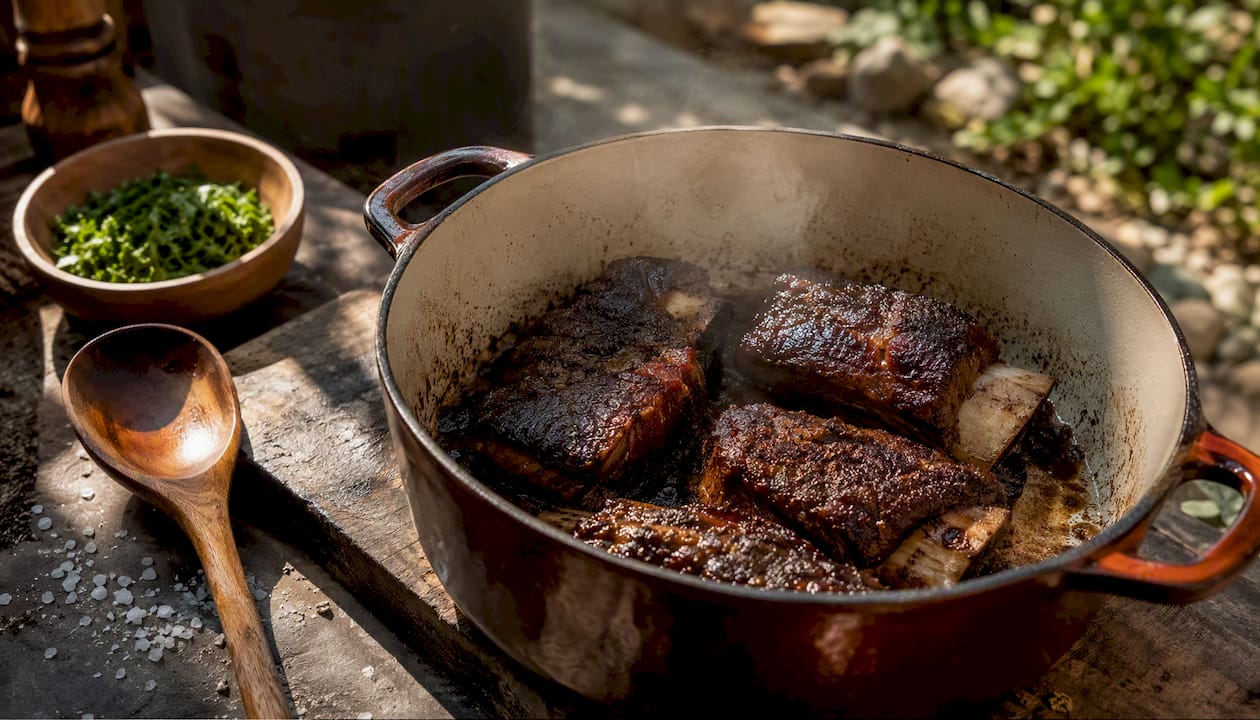
Braised Short Ribs: The Foolproof Oven Method
The most reliable way to get tender braised short ribs is a dry red wine oven braise: sear the ribs hard in a Dutch oven, sweat the aromatics, deglaze with wine, then cover and cook low and slow until the meat pulls apart with a fork. This is the method professional kitchens default to because oven heat surrounds the pot evenly, which matters more than any single ingredient.
Here’s the shape of it:
- Sear bone-in short ribs on all sides in batches (don’t crowd the pot).
- Soften onion, carrot, celery, and garlic in the fond, then stir in tomato paste.
- Deglaze with a full bottle of dry red wine, reduce slightly, then add stock until the ribs are nearly submerged.
- Cover and braise at 300°F to 350°F for 2 to 3 hours, checking for fork-tenderness starting around the two-hour mark.
Active prep runs about 30 minutes; the rest is unattended oven time. You can make this a day ahead, which actually improves it. A slow cooker or Instant Pot will get you to tender meat too, just with a different sauce and a different time commitment, covered further down.
Key Takeaways
The most reliable path to tender braised short ribs is a hard sear followed by a low, steady oven braise in wine and stock for 2 to 3 hours.
| Point | Details |
|---|---|
| Sear hard, in batches | Brown ribs in small batches over medium-high heat to build fond without steaming the meat. |
| Braise at 300°F to 350°F | Cover and cook 2 to 3 hours, checking fork-tenderness starting at the two-hour mark. |
| Judge by fork, not thermometer | Doneness means a fork twists in with almost no resistance, not a specific internal temperature. |
| Chill before serving if possible | Refrigerating overnight lets fat solidify for easy removal and deepens the sauce’s flavor. |
| Follow a tested recipe card | Forkwardkitchen’s red wine Dutch oven short ribs recipe applies this exact method with precise quantities. |
Table of Contents
- How to Braise Short Ribs: Ingredients You’ll Need
- What Equipment Do You Need for Dutch Oven Short Ribs?
- How Do You Braise Short Ribs in the Oven?
- Can You Make Braised Short Ribs in a Slow Cooker or Instant Pot?
- Which Red Wine Is Best for Braising Short Ribs?
- How Long Do Braised Short Ribs Take, and How Do You Know They’re Done?
- What Goes Wrong With Braised Short Ribs, and How Do You Fix It?
- Can You Make Braised Short Ribs Ahead of Time?
- What Should You Serve With Braised Short Ribs?
- Why Does the Oven Method Produce Such Tender Ribs?
- Sources
How to Braise Short Ribs: Ingredients You’ll Need
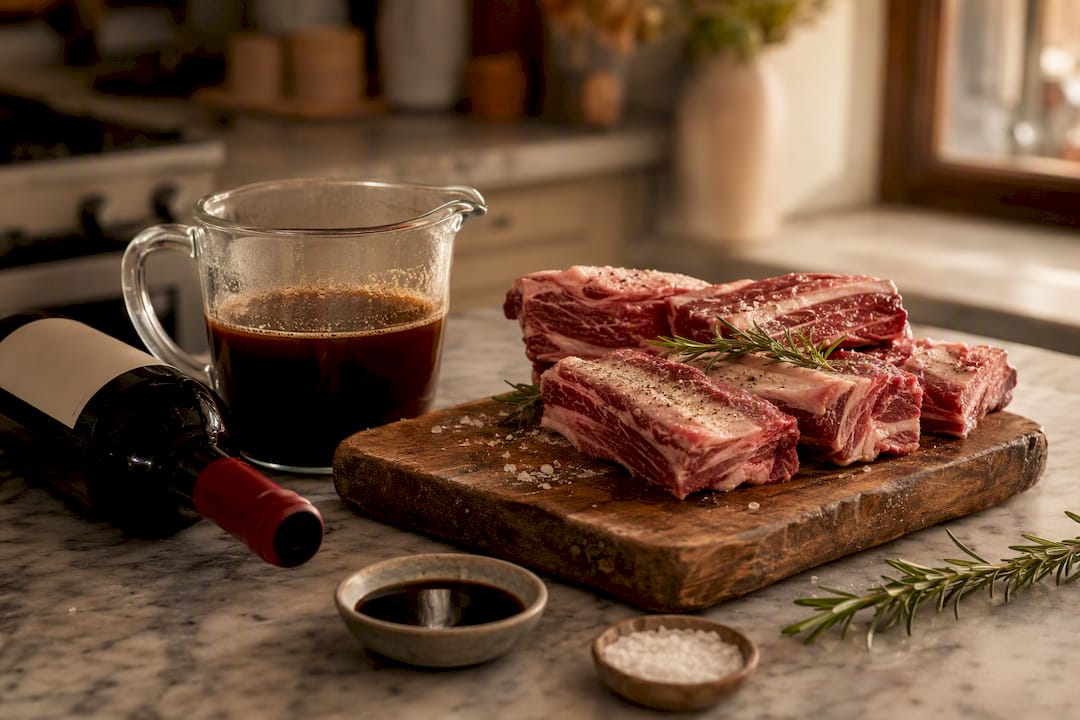
A classic red wine braise for 4 to 6 people needs surprisingly few ingredients, but the ratios matter more than most recipes let on.
- 4 to 5 pounds bone-in beef short ribs (English cut, about 2 inches thick)
- Kosher salt and freshly ground black pepper
- 3 tablespoons neutral oil (canola or vegetable)
- 1 large yellow onion, diced
- 2 carrots, peeled and diced
- 2 celery stalks, diced
- 4 to 5 garlic cloves, smashed
- 2 tablespoons tomato paste
- 750 ml dry red wine
- 3 to 4 cups beef or veal stock
- A few sprigs fresh thyme, 1 to 2 bay leaves
Trim any silverskin or excessive surface fat before cooking, and pat the ribs bone dry with paper towels. Wet meat won’t brown, it’ll steam, and a pale rib never develops the fond that carries the flavor of the whole braise. Let the ribs sit at room temperature for 20 to 30 minutes before searing, and dice your vegetables into uniform pieces so they cook at the same rate.
If you’re skipping the alcohol, swap the wine for extra stock plus two tablespoons of balsamic or red wine vinegar for the acidity you’d otherwise lose. For the wine itself, buy something you’d actually pour into a glass. A dry, full-bodied red like Cabernet Sauvignon, Merlot, or Pinot Noir works, and cooking concentrates whatever flaws a bottle already has. At the butcher counter, ask specifically for the thickest, meatiest ribs available, since the cut loses significant volume over a long braise.
What Equipment Do You Need for Dutch Oven Short Ribs?
You need one good heavy pot more than any gadget. A 6 to 7-quart Dutch oven or enameled cast-iron braiser with a tight-fitting lid is the backbone of this recipe, since it moves from stovetop searing straight into the oven without a dish change.
- Heavy Dutch oven or ovenproof braiser with a lid
- Tongs and a wide metal spatula for turning and scraping fond
- A sheet pan or plate to hold seared ribs between batches
- Fine-mesh strainer for the finished sauce
- A fork (more useful here than a thermometer)
An immersion blender or food mill is a nice extra if you want to purée the braising vegetables into the sauce for body, and a fat separator or wide spoon makes skimming easier once the pot has chilled.
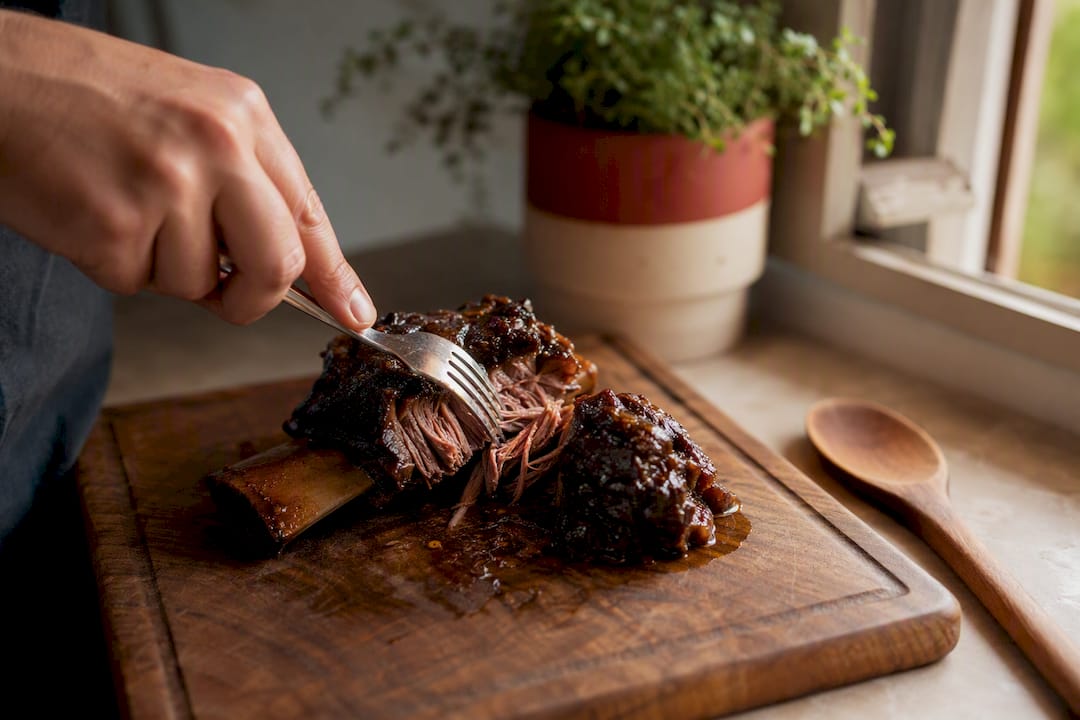
Pro Tip: Skip the strict-timer mindset. A meat thermometer tells you the ribs are safe to eat well before they’re actually tender. The fork test, where a fork twists in and the meat offers almost no resistance, is the real signal that collagen has broken down into gelatin.
How Do You Braise Short Ribs in the Oven?
This is the canonical method, the one that forgives small mistakes and produces consistent results every time.
- Season and rest. Salt the ribs generously on all sides, about ¾ teaspoon of kosher salt per pound, then pepper. Let them sit uncovered for 20 to 30 minutes so the salt draws to the surface and the meat isn’t cold going into the pan.
- Sear in batches. Heat oil in the Dutch oven over medium-high heat until it shimmers. Add ribs in a single layer without crowding, and sear each side for 2 to 4 minutes until deeply browned. Searing in batches over medium-high to high heat usually takes 10 to 15 minutes total for a full batch of ribs, and that crust is where most of the dish’s flavor actually comes from. Transfer seared ribs to a sheet pan and repeat until all pieces are browned.
- Build the aromatics. Lower the heat to medium, add onion, carrot, and celery to the fond left in the pot, and cook for 5 to 7 minutes until softened. Add garlic and cook another minute, then stir in tomato paste and cook it for 1 to 2 minutes until it darkens slightly and smells toasty rather than raw.
- Deglaze and reduce. Pour in the wine, scraping the bottom of the pot to lift every bit of browned fond. Bring to a simmer and let it reduce by roughly a third, which takes about 8 to 10 minutes; the wine should smell less sharp and look slightly syrupy.
- Add liquid and braise. Pour in stock until the ribs, once nested back into the pot, are nearly submerged but not swimming. Tuck in thyme and bay leaves, bring to a bare simmer on the stovetop, then cover and transfer to a 300°F to 350°F oven.
- Check and finish. Start checking at the two-hour mark. The ribs are done when a fork twists in with almost no resistance, which usually happens between 2 and 3 hours total. If the sauce is thin, finish the last 20 minutes uncovered to reduce it, or pull the ribs and simmer the liquid separately on the stovetop.
Once done, lift the ribs out carefully; they’ll be fragile. Let everything cool slightly before deciding whether to strain the sauce for a clean gravy or purée the softened vegetables back in for a thicker, rustic finish. If you’re not serving right away, chilling the whole pot overnight makes skimming the surface fat far easier the next day.
Photos help here more than words: what a properly seared rib crust looks like (mahogany brown, not gray), what “reduced by a third” looks like in the wine, and what the fork actually does when the meat is ready. If you’re working from a recipe card with step photos, lean on those images at the searing and fork-test stages especially.
Can You Make Braised Short Ribs in a Slow Cooker or Instant Pot?
Yes, and each method trades something for convenience. The oven stays the most forgiving option because ambient heat surrounds the pot evenly and won’t scorch the sauce the way direct stovetop heat can.
| Method | Time | Texture and sauce notes |
|---|---|---|
| Oven (Dutch oven) | 2 to 3 hours at 300°F to 350°F | Most forgiving; sauce reduces naturally alongside the meat |
| Slow cooker | About 8 hours on low | Very hands-off, but sauce stays thin and needs stovetop reduction after |
| Instant Pot / pressure cooker | 45 minutes including natural or manual pressure release | Fastest; texture is slightly less silky than a long oven braise |
Sear the ribs first no matter which method you choose. That step builds the fond that gives the finished sauce its depth, and skipping it is the single biggest reason slow cooker and Instant Pot versions taste flat.
- For a slow cooker, sear and build the aromatic base in a skillet, then transfer everything to the slow cooker insert with the wine and stock.
- For an Instant Pot, keep total liquid at or above the manufacturer’s minimum fill line, and add wine slowly since it can spatter against the hot pot bottom.
- Release pressure carefully, ideally with a natural release of 10 to 15 minutes before venting, to avoid violent boil-over through the valve.
- After either method, pour the braising liquid into a saucepan and reduce it on the stovetop for 10 to 15 minutes, or run the finished dish under a broiler briefly to tighten the sauce.
If you want a dedicated slow cooker or pressure cooker workflow written out start to finish, Forkwardkitchen’s crockpot beef stew with red wine and Instant Pot beef stew recipes use the same wine-and-stock logic in each appliance.
Which Red Wine Is Best for Braising Short Ribs?
Reach for something dry and full-bodied. Cabernet Sauvignon, Merlot, and Pinot Noir all work, and the difference between them is mostly how bold you want the final flavor. Cabernet gives you a darker, tannic backbone; Pinot Noir leans lighter and brighter; Merlot sits comfortably in between. The one rule that actually matters: buy a bottle you’d be happy drinking, because cooking down a bad wine just concentrates its flaws.
Most recipes use a full 750 ml bottle for real depth, paired with enough stock to bring the liquid up to nearly cover the ribs. That’s roughly a 1:1 wine-to-stock ratio if you want pronounced wine flavor, or closer to 1:2 wine-to-stock if you’d rather the beef stay front and center. Reducing the wine by a third before adding stock concentrates its flavor further; skipping that reduction and adding wine straight into the braise gives a lighter, less winey result.
If you’re avoiding alcohol, a few substitutes work without collapsing the dish:
- Extra beef stock plus 2 tablespoons red wine vinegar or balsamic vinegar for acidity
- A dark beer or hard cider for a different, still complex flavor profile
- Concentrated tomato paste and stock for a heartier, more rustic braise
- Non-alcoholic wine, which mimics body and some acidity but lacks the tannic backbone real wine provides
How Long Do Braised Short Ribs Take, and How Do You Know They’re Done?
Plan on 2 to 3 hours in the oven at a temperature somewhere between 300°F and 350°F, with 325°F as the most common middle ground. Start checking at the two-hour mark rather than assuming the clock alone tells you anything.
- Fork-tender is the goal: a fork should twist into the meat and meet almost no resistance.
- The meat should be pulling away slightly from the bone, not clinging tight to it.
- Collagen needs time to convert to gelatin, which is why rushing the temperature up doesn’t actually speed real tenderness.
- An instant-read thermometer is less useful here than the fork test, since short ribs are done by texture, not a target internal number.
If the ribs are still tough at the three-hour mark, they’re not ruined. Cover the pot again, drop the oven to 300°F, and give them another 30 to 45 minutes. A small splash of acid, like a teaspoon of vinegar, can help loosen stubborn connective tissue during that extra time.
What Goes Wrong With Braised Short Ribs, and How Do You Fix It?
Most bad results trace back to one of a handful of repeatable mistakes.
- Overcrowding the pot while searing. Crowded ribs steam instead of browning, which kills the fond. Sear in smaller batches and deglaze between rounds if the fond starts to burn.
- Not reducing the wine enough. Raw, unreduced wine tastes sharp and thin in the final sauce. Simmer it down until it looks slightly syrupy before adding stock.
- Too much or too little braising liquid. Ribs swimming in liquid dilute the sauce; ribs barely covered risk drying out on top. Aim for liquid that comes most of the way up the ribs, and finish uncovered if the sauce needs to concentrate.
- Skipping the rest and chill step. Serving straight from the pot means fighting a layer of hot fat on top of the sauce. Chilling overnight lets the fat solidify for easy removal, and it lets the flavors settle and deepen.
Pro Tip: Refrigerate the finished braise overnight, then lift off the solid disk of fat that forms on top before reheating. That single step is the difference between a glossy sauce and a greasy one.
Can You Make Braised Short Ribs Ahead of Time?
Braised short ribs improve overnight in the refrigerator, which makes this one of the better make-ahead dishes for entertaining.
- Cool the finished braise to room temperature, then refrigerate it covered, ideally overnight so the surface fat solidifies and lifts off cleanly.
- Store in the refrigerator for 3 to 4 days, or freeze for up to 3 months in an airtight container with the sauce covering the meat to prevent freezer burn.
- Reheat gently, either covered in a 325°F oven or in a covered pot on low stovetop heat, stirring occasionally. Skip the microwave, since it breaks down the meat’s texture unevenly.
- For entertaining, cook the full braise on day one, chill and skim the fat on day two, then reduce the sauce and reheat everything gently the day you plan to serve.
What Should You Serve With Braised Short Ribs?
Short ribs want something starchy underneath to catch the sauce, and something green on the side to cut the richness.
- Creamy mashed potatoes, soft polenta, or buttered egg noodles all work as a base.
- Creamy grits are a good Southern-leaning alternative to polenta.
- Roasted root vegetables or simply dressed greens balance the fat without competing for attention.
Before plating, strain the braising liquid and reduce it further on the stovetop if it needs body, then stir in a small pat of butter for shine or a splash of vinegar if it tastes flat. Serve the ribs over the starch of choice so the sauce pools around the meat, and finish with chopped parsley or a simple gremolata for a hit of brightness against all that richness.
Pro Tip: Don’t toss leftover braising liquid or scraps of meat. Shred extra rib meat into sandwiches, or turn a whole leftover batch into a slow-braised short rib ragu for pappardelle, which reduces the same sauce down further into something thick enough to coat pasta.
Why Does the Oven Method Produce Such Tender Ribs?
The science is straightforward once you see it laid out. Searing builds a deep brown crust, the fond, that carries most of the dish’s savory depth once it’s scraped up and dissolved into the sauce. Long, moist, low heat then converts tough collagen in the meat into gelatin, which is what makes the texture go from chewy to almost spoonable. Low-and-slow temperatures give that conversion time to happen fully instead of forcing the muscle fibers to seize up under high heat.
- Searing at high heat first, then dropping to low, gentle heat for hours, gives you both flavor and texture.
- Oven heat surrounds the pot from all sides, which is why oven braising scorches far less often than stovetop braising.
- Collagen breakdown is time-dependent, not just temperature-dependent, which is why rushing the process with higher heat backfires.
The oven’s even, ambient heat is what makes this method nearly impossible to mess up. You lose the risk of a scorched pot bottom that stovetop braising carries, and that reliability is why this stays the go-to approach for a dish that has almost no margin for shortcuts.
Forkwardkitchen’s tested red wine Dutch oven short ribs recipe follows this exact logic, and the silky reduction variation shows what the sauce looks like when you take the extra step to strain and concentrate it.
A Cook’s Honest Take on This Recipe
This braise earns its reputation because it doesn’t demand precision, just patience. You can be a little sloppy with vegetable dice sizes or run the oven at 310°F instead of exactly 325°F and still land on tender ribs, which is rare for a recipe that sounds this involved.
Difficulty: moderate, better suited to a confident home cook or a patient beginner willing to give it an unhurried afternoon, and genuinely ideal for hosts who want to cook a day ahead and reheat.
Where to Find More Tested Braises
Forkwardkitchen builds every recipe from scratch and tests it in a real kitchen before it goes live, which is why the timing and doneness cues in this guide match what actually happens in a home oven, not a lab. If this braise wonered you over, the full recipe index has other slow-cooked, low-and-slow dishes worth trying next, and the red wine Dutch oven short ribs recipe card walks through this exact method with exact quantities if you want a printable version to cook from tonight.
Once you’ve got a pot of ribs going, browse Forkwardkitchen’s recipe index for what to make next, whether that’s a pasta dish to pair with leftover sauce or another weekend braise to add to the rotation.
Sources
- How to cook beef short ribs | Snake River Farms
- Best wine with short ribs | MeatPairing
- How to pick the best short ribs | Tasting Table
- Braised short ribs differ in texture when on stove top vs in oven | Cooking Stack Exchange